KodeFlex vs Lovable: Structured Workflows vs Prompt-Only Web Apps
July 21, 2026PUBLISHED INAi Development
 ali
ali 2026-07-21 15:03:00
 0
0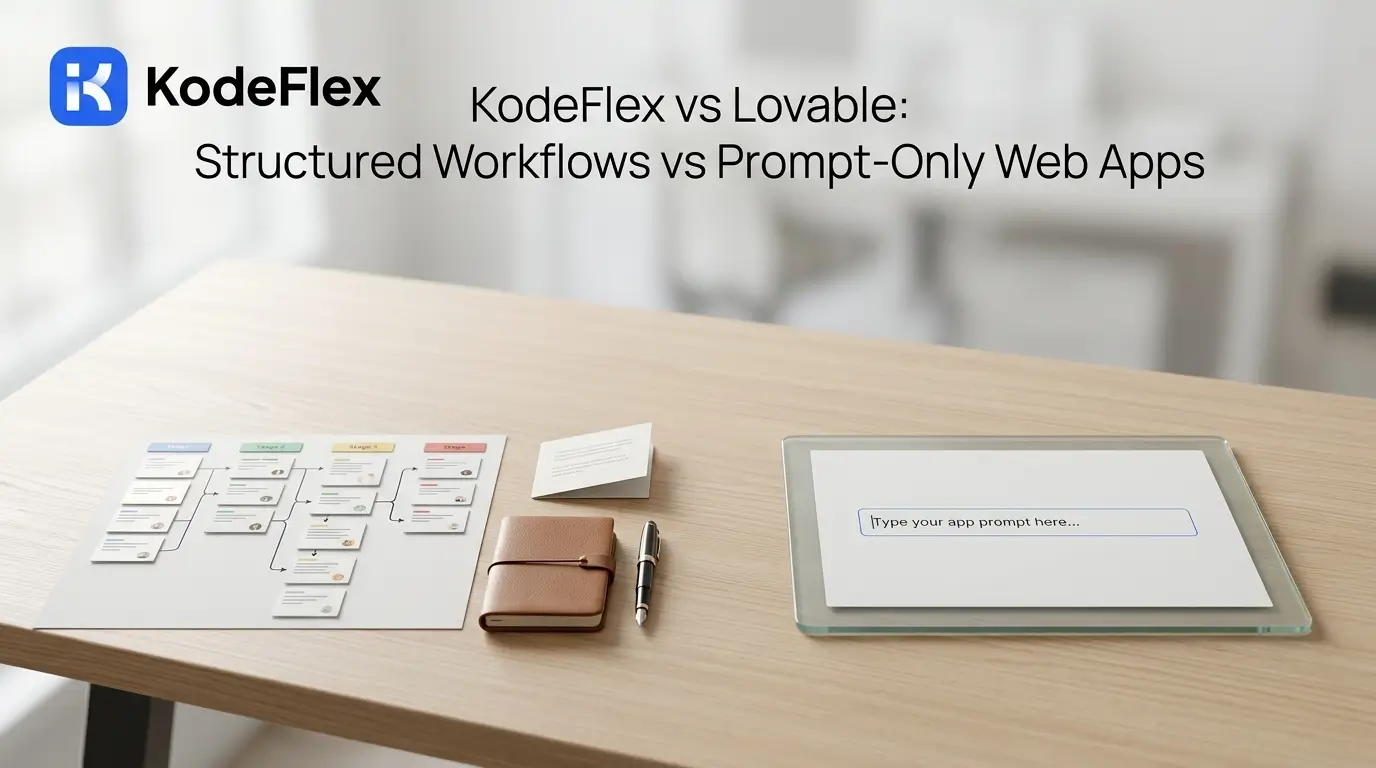
AI app builders have completely changed how fast an idea can turn into working software. A development team that used to take weeks now takes hours—sometimes just minutes. However, as more businesses turn to AI-assisted development platforms, the question arises: do speed and efficiency suffice, or is there a need for structure, governance, and sustainability for enterprise apps?
That's why you must compare KodeFlex and Lovable. Both are types of AI application builders but have very different philosophies in their design. Lovable is a tool built on top of the chat interface that can quickly transform natural language into a working web app—using prompts as its toolset. In contrast, KodeFlex is designed around a workflow engine, which is particularly suitable for enterprise collaboration scenarios where control of the process, approvals and long-term scalability are as important as being quick.
In this guide, we'll break down how KodeFlex and Lovable actually differ, where each one fits best, and how to decide which platform matches your project's real needs—not just your first prompt.
What Is KodeFlex?
KodeFlex is an AI development platform and AI application builder built on a workflow engine. It combines AI-powered development, text-to-app generation, and natural language development to convert enterprise requirements into runnable collaboration apps.
Instead of just generating a static prototype from a prompt, KodeFlex is designed around a structured delivery flow:
-
One-prompt app generation — describe a business requirement in natural language, and the platform generates a runnable application with structure, feature modules, front-end pages, and back-end logic
-
Visual workflow refinement — approvals, routing logic, trigger conditions, business rules, and branching can all be configured visually without rewriting code from scratch
-
Unified application operations — manage the full lifecycle of an app, from generation and design to preview, debugging, release, deployment, and version iteration
-
Flexible instance management — run multiple instances from a single application, create instances from any version, and handle upgrades or suspensions with less overhead
-
Private deployment support — this matters a lot for enterprises handling sensitive data, since it removes dependency on public cloud infrastructure
In short, KodeFlex treats app generation as the starting point of a much longer lifecycle, not the finish line.
What Is Lovable?
Lovable is a chat-based AI application builder that enables users to build applications and websites by simply stating their requirements in natural language. Built with a modern tech stack: React, Supabase, and Tailwind, it focuses on the flexibility of how users begin to create a project, whether it's by prompting, using templates, remixing existing projects, or even by simply taking a screenshot or design from Figma and converting it into functional code.
-
Some of Lovable's notable strengths include:
-
A shared workspace where PMs, designers, and engineers can collaborate to create, with engineers keeping control with the help of GitHub pull requests.
-
No lock-in: you can always export code to GitHub and deploy it anywhere
-
Seamlessly integrates AI capabilities, including chatbots, Q&A on documents, translation, and semantic search, without dealing with separate API keys.
-
Enterprise-grade security certifications, such as SOC 2 Type II and ISO 27001, plus SSO/SAML and role-based access control on premium plans.
Lovable helps product teams, startups, and founders quickly move from an idea to a fully functional prototype, often in just one day.
KodeFlex vs Lovable: Core Differences
Here's where the two platforms genuinely diverge—not in what they can build, but in how they get there and what happens after the first version ships.
Requirements approach
Lovable is prompt-only by design. You state what you want, and then the AI reads it and constructs it until you fine-tune it with the additional prompts. KodeFlex also supports natural language input but passes it through a workflow engine, meaning that the output is based on forms, actions, approvals, and business rules from the get-go.
Workflow and approval logic
This is arguably the biggest differentiator. KodeFlex has built-in support for deep customization of forms, approvals, and non-linear business logic, making it a strong fit for complex enterprise collaboration scenarios. Lovable's strength lies more in general-purpose app generation—SaaS dashboards, marketplaces, and internal tools—rather than approval-heavy internal enterprise processes.
Delivery quality
KodeFlex generates workflow configurations with built-in validation and error correction, aiming for enterprise-grade output that can be delivered directly. Lovable is excellent for fast prototyping, but even its own reviewers note that complex logic can trip up the AI, sometimes requiring manual cleanup before something is truly production-ready.
Deployment and data control
KodeFlex supports private deployment, which removes reliance on public cloud infrastructure entirely. Lovable apps are typically built and hosted using Supabase and cloud infrastructure, with enterprise-tier security certifications available, but the underlying architecture remains cloud-based.
Lifecycle and instance management
KodeFlex covers the full lifecycle: generation, design, preview, debugging, release, deployment, and version iteration, including running multiple instances from one app. Lovable's workflow centers more around building, iterating through prompts, and syncing to GitHub, with less emphasis on formal multi-instance lifecycle management.
Long-term iteration cost
KodeFlex is built around reducing repeated build costs, using workflow-based development to keep localized changes fast and predictable at scale. Lovable is optimized for quick, one-off builds—great for speed, but some users have reported that credit costs and complexity stack up as projects grow more advanced.
When Lovable Makes Sense
To be fair, Lovable is genuinely good at what it's designed for. It tends to be the better fit when:
-
You're a founder or small team validating an idea and need something functional fast
-
Your project is a standalone web app, landing page, or MVP rather than an internal enterprise system
-
You want a familiar tech stack (React, Supabase, Tailwind) that any developer can pick up later
-
You value flexibility in how you start—prompting, templates, screenshots, or Figma imports
-
Your team is comfortable iterating through prompts and cleaning up complex logic manually when needed
If speed-to-prototype is the main goal and the app doesn't involve heavy internal process logic, Lovable is a solid, well-regarded choice.
When KodeFlex Makes Sense
KodeFlex tends to be the stronger fit when:
-
You're building for internal enterprise collaboration, not just a public-facing app
-
Your process involves approvals, routing, conditional logic, or multi-step workflows
-
Data security requirements mean private or on-premise deployment isn't optional
-
You expect to manage multiple versions or instances of the same application over time
-
Long-term maintainability and lower iteration cost matter more than one-time build speed
If the app is meant to run and evolve inside a business for years, not just launch and be judged in its first week, KodeFlex's workflow-first approach becomes the more practical choice.
Enterprise Considerations: Security, Compliance, and Scalability
For enterprise buyers, the decision usually isn't just about how fast an app can be built—it's about who controls the data, how the app is governed over time, and how much rework is needed as requirements change.
The private deployment is especially important for industries that have strict data handling regulations, as it means that the application is within the enterprise's own infrastructure, thus eliminating the risk of data leakage at the physical layer.
Lovable boasts impressive compliance at the enterprise level, including SOC 2 Type II compliance and ISO 27001 certification, SSO/SAML, and audit logs with audit reports, making it a viable choice for teams that feel comfortable in a cloud-hosted environment.
They're both good strategies for enterprise security; the only thing that matters is whether your policies support the cloud or your app must remain entirely within the boundaries of your enterprise.
Which One Should You Choose?
The decision can be put simply:
-
If you want a quick and agile prototype and a standalone web app deployment, and you're okay with iteration and a cloud-based stack, select Lovable.
-
If you are building an internal enterprise solution that requires structure, approval workflows, and private deployment with long-term lifecycle management, you should consider KodeFlex.
So, the big question is, will you be distributing this app to the world, or will your organization be using it internally for years? That single detail usually steers in a definite direction, it seems, to one platform or the other.
FAQs
Is KodeFlex only for large enterprises, or can smaller teams use it too?
KodeFlex is optimized for enterprise collaboration scenarios, but its one-prompt generation and visual refinement make it accessible to smaller teams too. The workflow engine scales with complexity, so it works whether you're managing a small internal tool or a large multi-department process.
Can Lovable handle enterprise-level security requirements?
Yes, Lovable offers SOC 2 Type II and ISO 27001 certification along with SSO/SAML and role-based access control at the enterprise tier. However, its architecture remains cloud-based, so it may not suit organizations that require fully private, on-premise deployment.
Does KodeFlex require coding knowledge to use?
No, KodeFlex is designed so non-technical users can build apps by describing requirements in natural language. The AI handles semantic parsing and logic abstraction, while visual tools allow further refinement without writing code.
Which platform is better for building a quick MVP?
Lovable is generally faster for standalone MVPs and prototypes, thanks to its prompt-based, template, and remix-based entry points. KodeFlex is better suited when the MVP needs built-in approval logic or will evolve into a long-term internal system.
Can KodeFlex apps be integrated with existing enterprise systems?
KodeFlex's workflow engine and unified operations layer are designed to support enterprise-grade delivery, including structured, editable outputs that reduce rework. This makes it easier to align generated apps with existing internal processes and systems over time.
Conclusion
Both KodeFlex and Lovable represent where AI-powered development is heading—turning natural language into working software far faster than traditional coding ever allowed. However, “faster” doesn't necessarily mean “the same.” Lovable is optimized for fast and flexible creation of apps through prompts, and KodeFlex is optimized for structured workflows, enterprise governance, and long-term operational control.
KodeFlex is tailored for the use case of businesses that require an AI application builder that goes beyond prototyping and allows for private deployment, with approvals and full lifecycle management.
Ready to see how KodeFlex handles your enterprise workflows? Book a demo and explore how one-prompt generation, visual workflow refinement, and private deployment come together in a single platform.
Related Blogs
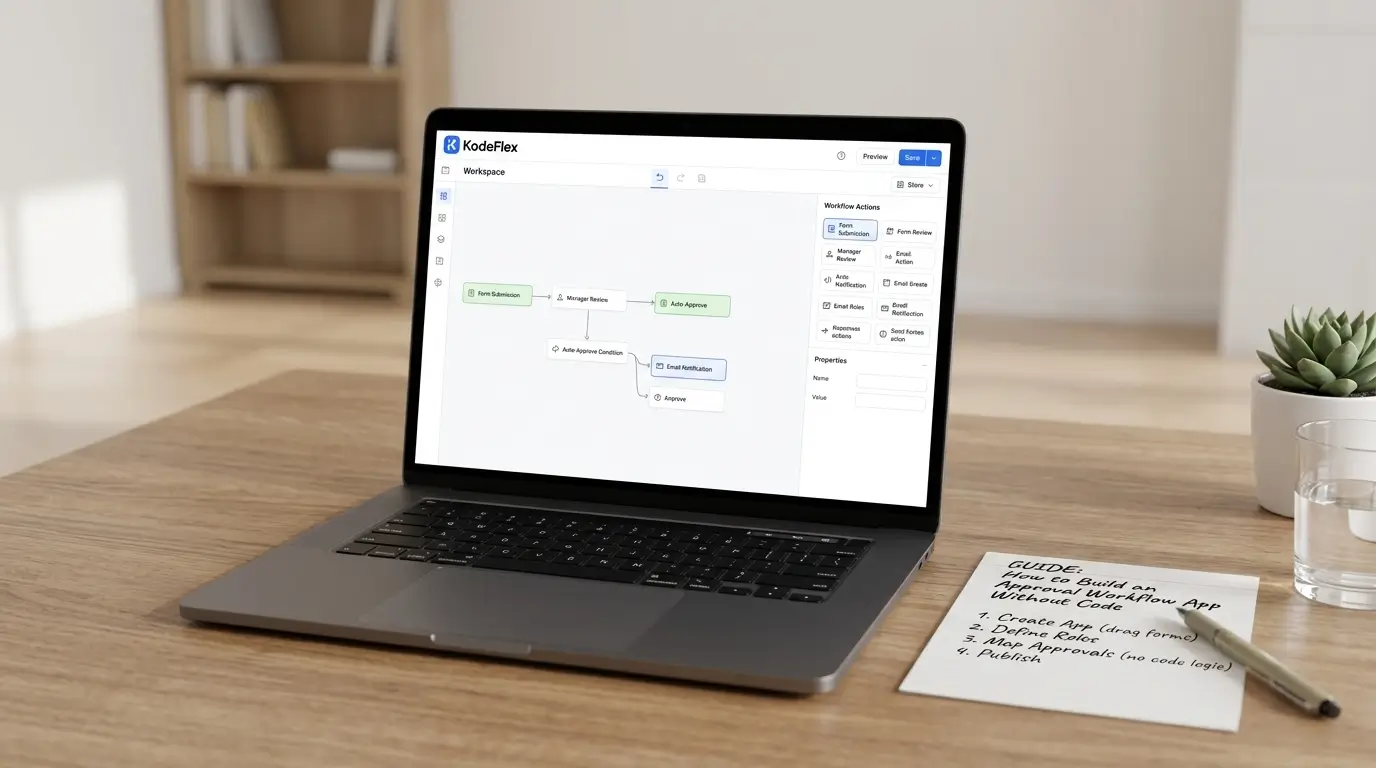
How to Build an Approval Workflow App Without Code