KodeFlex vs Mendix: Which Platform Fits Your Enterprise?
August 21, 2026PUBLISHED INAI Development
 ali
 2026-08-21 17:57:00
 0
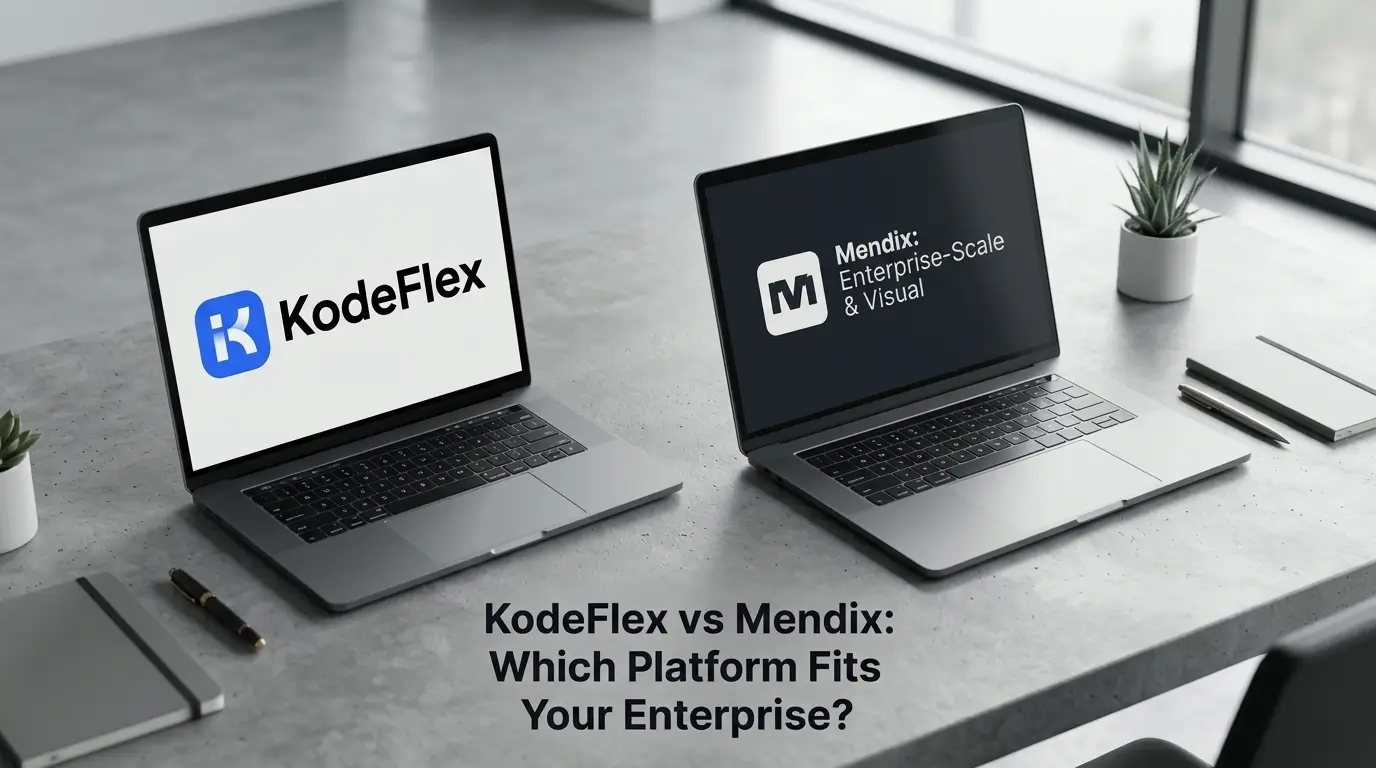
Mendix has been a major name in low-code since 2005, built around visual, model-driven development for large-scale enterprise application portfolios. KodeFlex takes a different starting point, generating a working app from a plain-language description rather than a visual model. Both are aimed at enterprises, but at meaningfully different points in team size, budget, and how many apps you're actually planning to build.
Pricing: Where the Real Gap Shows Up
Mendix's free tier is genuinely limited, it's built for learning and proof-of-concept work, and doesn't let you publish a live app. Real production use starts at the Standard tier, roughly $1,090 per month for one app or around $2,100 per month for unlimited apps, with Premium and Enterprise tiers running custom pricing on top. Industry benchmarking of actual Mendix contracts shows small-to-medium businesses commonly spending $80,000 to $300,000 annually, and large enterprises running 100+ applications spending $1 million to $4 million or more per year. Check KodeFlex's pricing for a much simpler comparison, since KodeFlex isn't priced around a large, multi-app enterprise portfolio the way Mendix's tiering is built.
What That Spend Actually Buys
Mendix's pricing reflects real capability at scale: a mature platform for managing dozens or hundreds of applications across a large organization, with dedicated database tenancy, multiple environments per app, and infrastructure built for that kind of portfolio management. That's genuinely valuable if you're running a large enterprise app estate with a dedicated development team. It's a much harder cost to justify if what you actually need is a handful of workflow apps solving specific department-level problems.
Speed and Who's Doing the Building
Mendix's visual, model-driven approach is faster than hand-coding but still involves real development work, data models, microflows, page design, assembled by someone trained on the platform, and reviewers consistently note a real learning curve. KodeFlex generates that starting structure from a description, then hands it to a visual canvas for refinement, aimed at getting a non-technical business user to a working draft without first learning a modeling methodology.
Feature Comparison
|
KodeFlex |
Mendix |
|
|
Starting point |
AI generates a working app from a plain-language description |
Visual, model-driven low-code development |
|
Entry pricing |
See current plans on the pricing page |
Standard from ~$1,090/mo per app (~$2,100/mo unlimited apps); free tier can't publish |
|
Typical enterprise spend |
See current plans on the pricing page |
$80K-$300K/year (SMB) up to $1M-$4M+/year at large enterprise scale |
|
Deployment |
Cloud or private deployment |
On-premise or SaaS available |
|
Best for |
Fast-turnaround workflow apps for business teams |
Large enterprises building complex, multi-app portfolios with dedicated dev teams |
Who Should Pick Which
Mendix tends to fit large enterprises managing many applications across departments, with a dedicated development team and budget that scales into six or seven figures annually. KodeFlex tends to fit teams that need workflow-driven business apps built quickly, without the enterprise-portfolio pricing model and platform learning curve Mendix assumes from the start.
Frequently Asked Questions
Is Mendix's free tier usable for a real app?
Not for production use, the free tier is designed for learning and proof-of-concept work and doesn't allow publishing a live application.
How much does Mendix actually cost for a mid-size company?
Based on industry contract analysis, small-to-medium businesses commonly spend $80,000 to $300,000 annually, well above the entry list price once real usage is factored in.
Does Mendix require specialized training?
Its visual, model-driven approach has a real learning curve compared to hand-coding, and organizations often use Mendix's Expert Services for complex integration projects.
Is KodeFlex cheaper than Mendix for a single department app?
Generally yes, since KodeFlex isn't priced around a large multi-app enterprise portfolio the way Mendix's tiering structure is.
Can Mendix handle more complex, large-scale application portfolios than KodeFlex?
For organizations managing dozens or hundreds of interconnected applications with a dedicated dev team, Mendix's maturity at that scale is a real differentiator.
Want to see how fast a working app comes together without enterprise portfolio pricing?
Request a demo and describe the app you need.
Related Blogs
KodeFlex vs OutSystems: Low-Code vs AI-Native Development