KodeFlex vs Retool: AI App Generation Compared
August 20, 2026PUBLISHED INAI Development
 ali
 2026-08-20 15:35:00
 0
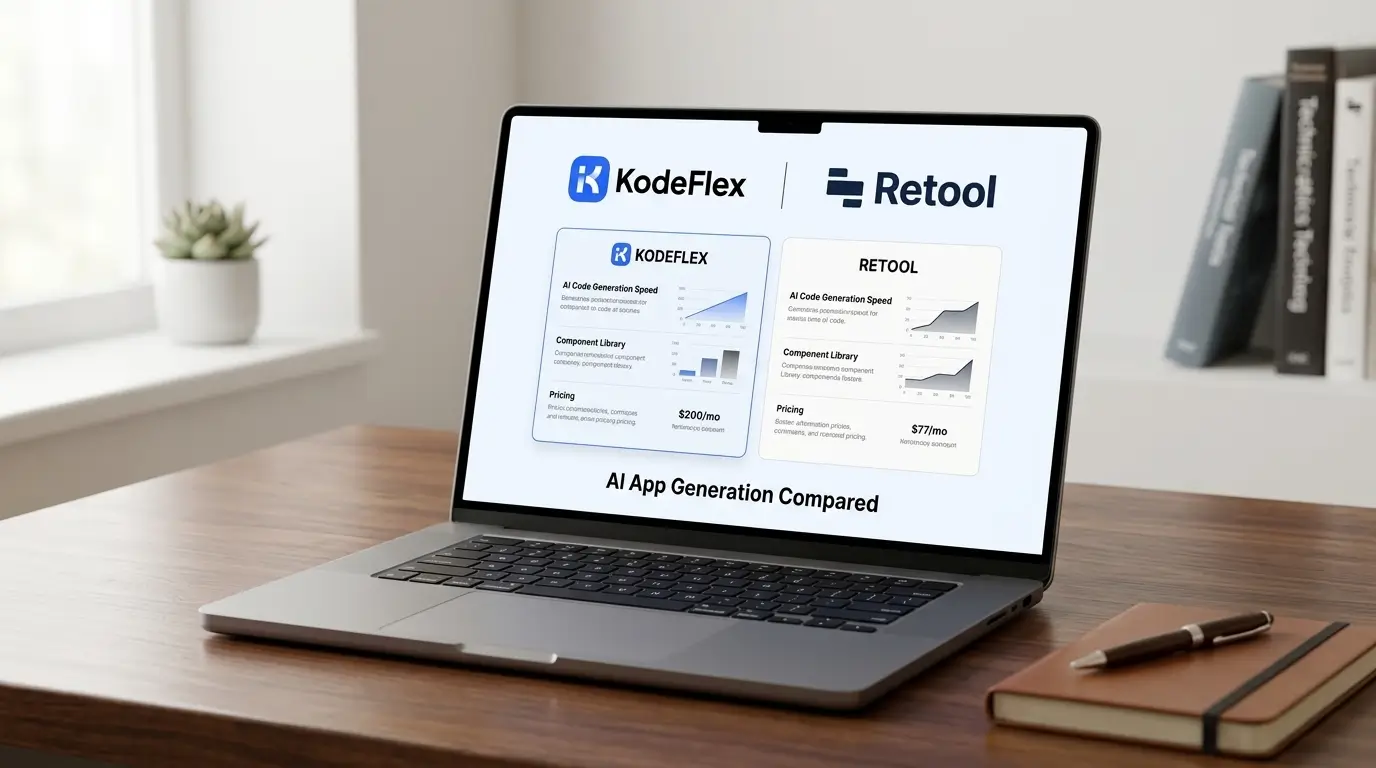
Retool and KodeFlex both build internal tools, but they're aimed at fairly different builders. Retool is a low-code platform built primarily for developers, strong database and API connectivity, drag-and-drop components, with the expectation that you'll write some JavaScript or SQL when the pre-built pieces don't quite cover what you need. KodeFlex is built around generating the app from a description first, aimed at letting non-technical business users build without touching code at all.
Here's how that difference plays out.
Who's Actually Meant to Build the App
Retool assumes a developer, or at least someone comfortable with SQL and JavaScript, is doing the building. That's not a weakness, it's a deliberate design choice that gives Retool serious flexibility for connecting to complex data sources and building genuinely sophisticated admin tools. But it does mean the IT backlog problem, business users waiting on developer time, doesn't fully go away with Retool the way it might with a tool designed for non-technical builders. KodeFlex is built specifically to let the person who understands the process, not necessarily a developer, describe it and get a working app without writing code at any point.
Pricing: A Genuinely Complex Model
Retool's pricing is one of the more complicated models in this category. Costs are billed across three distinct user types, builders (people who create or edit apps), internal users (people who only use published apps), and external users (customers or partners accessing apps you've built), each priced differently and calculated based on actual activity during the billing cycle. Team runs around $10 per builder per month annually, Business around $50 per builder per month annually, with internal users billed separately at a lower rate, and overages billed at higher monthly rates if usage exceeds what's prepaid. It's a genuinely flexible model for teams with very different user mixes, but it also means the final bill takes real effort to estimate accurately. Check KodeFlex's pricing page for a more straightforward comparison.
Workflow Logic vs Data Connectivity
Retool's core strength is connecting to and manipulating data from many different sources, databases, APIs, third-party services, with a rich component library for building the interface on top. Business logic and approval workflows are absolutely buildable, but they're typically assembled through a combination of components and custom code rather than a dedicated workflow layer. KodeFlex takes the opposite emphasis: a built-in workflow engine handles approvals, branching, and routing natively, since that's the primary use case the platform is built around, with data connectivity supporting that workflow rather than being the main event.
Feature Comparison
|
KodeFlex |
Retool |
|
|
Starting point |
AI generates a working app from a plain-language description |
Drag-and-drop components, often paired with hand-written JavaScript and SQL |
|
Pricing model |
See current plans on the pricing page |
Three billed user types (builder, internal, external), activity-based, Team ~$10/builder/mo, Business ~$50/builder/mo |
|
Target user |
Non-technical business and IT staff |
Developers and technical teams building admin panels and internal tools |
|
Workflow logic |
Built-in workflow engine for approvals, branching, multi-role routing |
Strong database and API connectivity; workflow logic often built with custom code |
|
Best for |
Business teams building approval and process apps quickly |
Engineering teams building data-heavy admin tools and dashboards |
Who Should Pick Which
Retool tends to fit engineering teams building data-heavy internal tools, admin panels, ops dashboards, tools that need to talk to several complex data sources, where having a developer in the loop is expected and even preferred. KodeFlex tends to fit teams that need workflow-driven business apps, approvals, requests, tracking, built fast by the people who understand the process, without routing every small request through engineering.
Frequently Asked Questions
Do I need to know how to code to use Retool?
Not strictly, but Retool's real flexibility comes from JavaScript and SQL knowledge. Non-technical users can use it, but often hit limits without some technical support.
Is Retool's pricing hard to estimate?
It can be, since costs depend on three different user types billed at different rates based on actual monthly activity, rather than a flat per-seat price.
Does Retool offer self-hosted deployment?
Self-hosted deployment is available, typically as part of higher-tier plans. Confirm current details directly with Retool for your specific plan.
Which is better for connecting to complex, multiple databases?
Retool's core strength is broad database and API connectivity, making it a strong fit when an app needs to pull from several complex data sources.
Which is better for a business user with no technical background?
KodeFlex is built specifically for that case, generating a working app from a description rather than requiring component assembly and custom code.
Want to see what a non-technical team can build without touching code?
Request a demo and describe the app you need.
Related Blogs
KodeFlex vs Bubble: Which AI App Builder Is Right for Enterprise?