AI vs Automation: What’s the Real Difference?
11 days agoPUBLISHED INAi Development
 ali
ali 2026-09-12 14:56:00
 0
0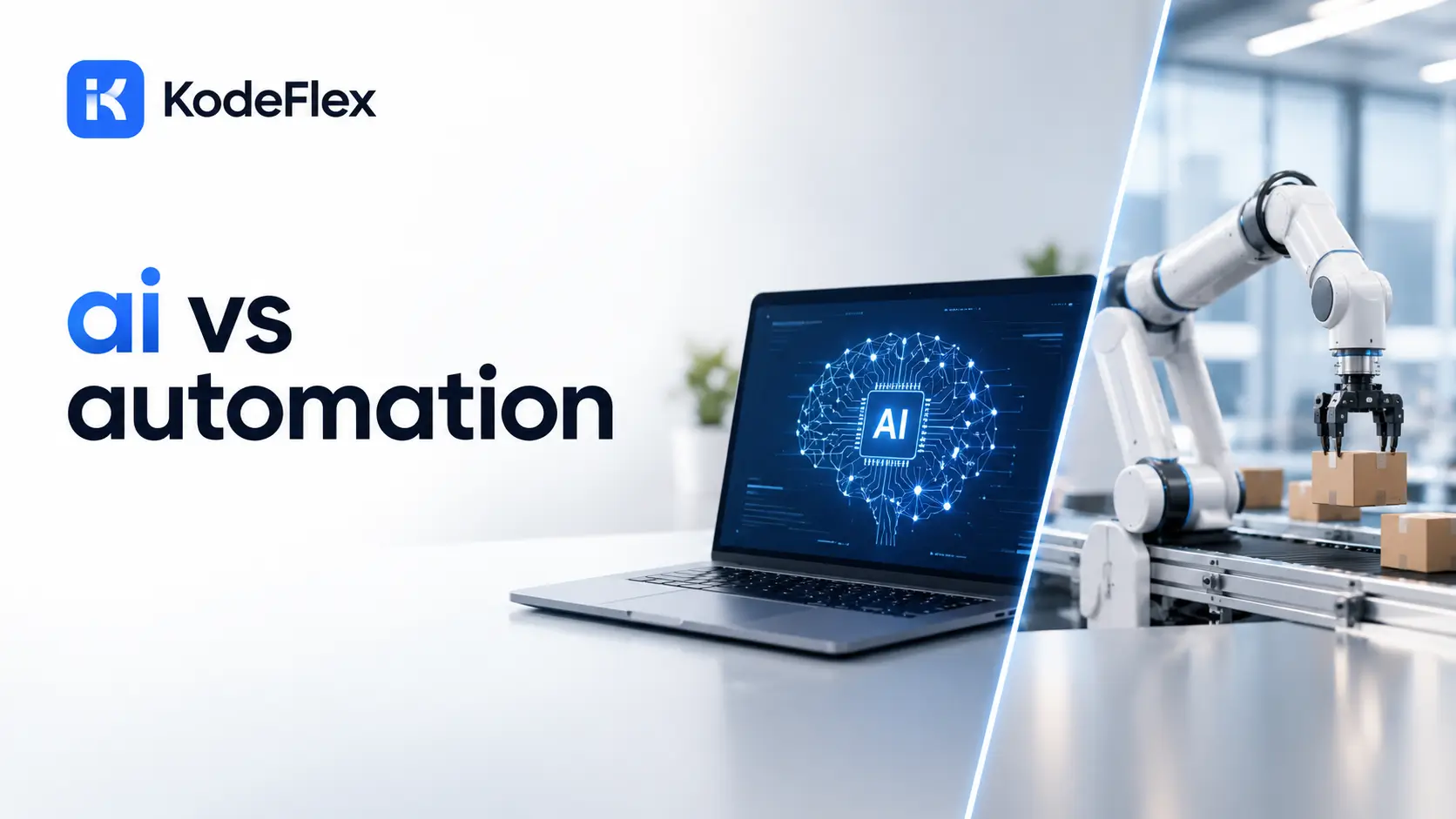
People use “AI” and “automation” interchangeably in meetings all the time, and it causes more confusion than it should. The AI vs automation question comes up constantly in planning discussions, and getting it wrong either wastes money or builds something far less reliable than it needed to be. Here’s the actual difference, with real examples of when each one is the right call.
What Is the Real Difference Between AI and Automation?
Automation follows fixed rules you define ahead of time. AI makes judgment calls based on patterns, context, and information it wasn’t explicitly told step by step. That distinction sounds simple, but it changes everything about how you should build a workflow.
A Simple Way to Tell Them Apart
-
If the logic is “when X happens, always do Y,” that’s automation
-
If the logic requires interpreting something ambiguous, like reading a customer message and deciding how urgent it is, that’s AI
-
If you can write the entire decision tree on a whiteboard in five minutes, you probably need automation, not AI
When Should You Use Plain Automation?
Automation is the right tool whenever a task follows the same steps every single time, with no real judgment required. It’s cheaper, faster, and far more predictable than AI for this kind of work.
-
Sending a confirmation email the moment someone submits a form
-
Moving a record from one status to another once a specific field changes
-
Triggering a Slack notification when a deadline is missed
-
Syncing a new row in one system to a matching record in another
Automation tools like Zapier, Make, and n8n exist specifically for this category. Zapier starts around $19.99 monthly for a basic plan, Make starts closer to $9 monthly, and n8n runs from about $20 monthly on its cloud plan or free if you self host it. None of these platforms are making judgment calls. They’re executing exactly the rule you gave them, every time, without deviation.
When Should You Actually Reach for AI Instead?
AI earns its cost when a task requires understanding context, unstructured information, or judgment that can’t be reduced to a fixed rule.
Real Examples Where AI Makes Sense
-
Reading an incoming support ticket, understanding what the customer actually needs, and drafting a reply based on your documentation
-
Reviewing a contract and flagging clauses that look unusual compared to your standard terms
-
Summarizing a long thread of customer feedback into a few clear themes
-
Deciding how to route an ambiguous request between departments based on its actual content, not just a keyword match
Customer service is currently the most mature use case for this kind of AI work. Industry data shows customer service now makes up roughly a quarter of all real AI agent deployments, more than any other business function. That’s not a coincidence. Support tickets are exactly the kind of unstructured, judgment heavy task automation alone was never built to handle well.
Can AI and Automation Work Together?
Yes, and honestly, the best business workflows almost always combine both rather than picking one exclusively. This layered approach is often called workflow orchestration.
How the Two Layers Typically Split
-
Automation handles the predictable, repetitive steps: moving data, triggering notifications, updating statuses
-
AI handles the judgment calls sitting inside that same workflow: reading a message, deciding urgency, drafting a first response
-
A human still approves anything with real consequences, like an unusual refund or a contract exception
A concrete example: an approval workflow for expense reports can use plain automation to route the form to the right manager based on department, then use AI to flag anything unusual compared to the employee’s typical spending pattern, then fall back to a human for the final approval. Neither layer alone does the whole job well.
How Do You Decide Which One Your Workflow Actually Needs?
Start by asking whether the task involves judgment or just repetition. That single question resolves most of the confusion.
-
Repetitive, rule based, same steps every time? Build it with plain automation, it will be cheaper and more reliable
-
Requires reading context, unstructured text, or making a judgment call? That’s where AI earns its cost
-
Involves both? Layer them together rather than forcing one tool to do a job it wasn’t built for
Getting this wrong in either direction causes real problems. Using AI for a task that’s genuinely just repetitive wastes money and introduces unpredictability where you don’t need any. Using plain automation for a task that actually requires judgment produces broken, rigid results that frustrate the people relying on it.
What Do Teams Usually Get Wrong About AI vs Automation?
Most confusion comes from treating the two as competing options instead of different tools for different jobs.
Common Misconceptions Worth Clearing Up
-
Assuming AI is always “smarter” and therefore always the better choice, when a fixed rule is often more reliable for repetitive tasks
-
Assuming automation can’t handle anything complex, when a well designed automation workflow can chain dozens of precise steps together reliably
-
Assuming adding AI to a workflow automatically makes it more accurate, when a poorly scoped AI step can introduce inconsistency a fixed rule never would
-
Assuming the choice is permanent, when most mature workflows evolve, starting as plain automation and adding AI steps only where judgment genuinely becomes necessary
A support team migrating from a simple ticket router to something more sophisticated often makes this mistake in reverse too, throwing AI at every step instead of just the one step that actually needed judgment, like reading tone and urgency. The routing itself, moving the ticket to the right queue once a category is assigned, usually works better as plain automation.
What Does This Look Like in a Real Business Workflow?
Picture a mid sized company handling vendor invoices every week. The AI vs automation split in that single workflow usually breaks down like this:
-
Automation extracts the invoice data from a PDF and populates a record, the same steps every time
-
Automation routes that record to the right approver based on department and amount, another fixed rule
-
AI reviews the invoice against typical spending patterns and flags anything that looks unusual for that vendor
-
A human makes the final call on anything flagged, since that judgment carries real financial consequences
Every piece of that workflow does the job it’s actually suited for. Nothing is forced to do work it wasn’t built for.
Frequently Asked Questions
Is automation cheaper than AI?
Usually, yes, for tasks that are genuinely repetitive. AI costs more per action but handles judgment calls automation simply can’t.
Can automation tools like Zapier use AI at all?
Increasingly, yes. Most major automation platforms now offer AI powered steps you can drop into an otherwise rule based workflow.
Do I need AI for my business, or is automation actually enough?
Look at your actual tasks first. Many businesses assume they need AI when plain automation would solve 80 percent of what they’re dealing with, for a fraction of the cost.
What happens when a workflow needs both AI and automation together?
This combined approach is generally called workflow orchestration, and it’s how most mature business processes actually get built today. For a deeper look at how this works, see this guide on workflow orchestration.
Is an AI app builder the same thing as an automation tool?
No. An automation tool connects existing apps and triggers actions. An AI app builder generates the actual application, forms, database, and logic, from a written description.
How do I explain AI vs automation to a non technical stakeholder?
Automation is a machine following exact instructions every time. AI is a machine making a judgment call based on context, closer to how a person would size up a situation than to a fixed checklist. That framing usually lands better in a meeting than a technical definition.
Building a workflow that needs both a real application and judgment based logic behind it?
See how KodeFlex generates a working app from a plain language description, or request a demo to see how approval logic and AI generated screens work together in practice.
Related Blogs

Best No Code App Builders in 2026 (Buyer’s Guide)