App Builder for Hospitality: Hotels and Restaurants
2 hours agoPUBLISHED INAi Development
 ali
ali 2026-10-07 14:32:00
 0
0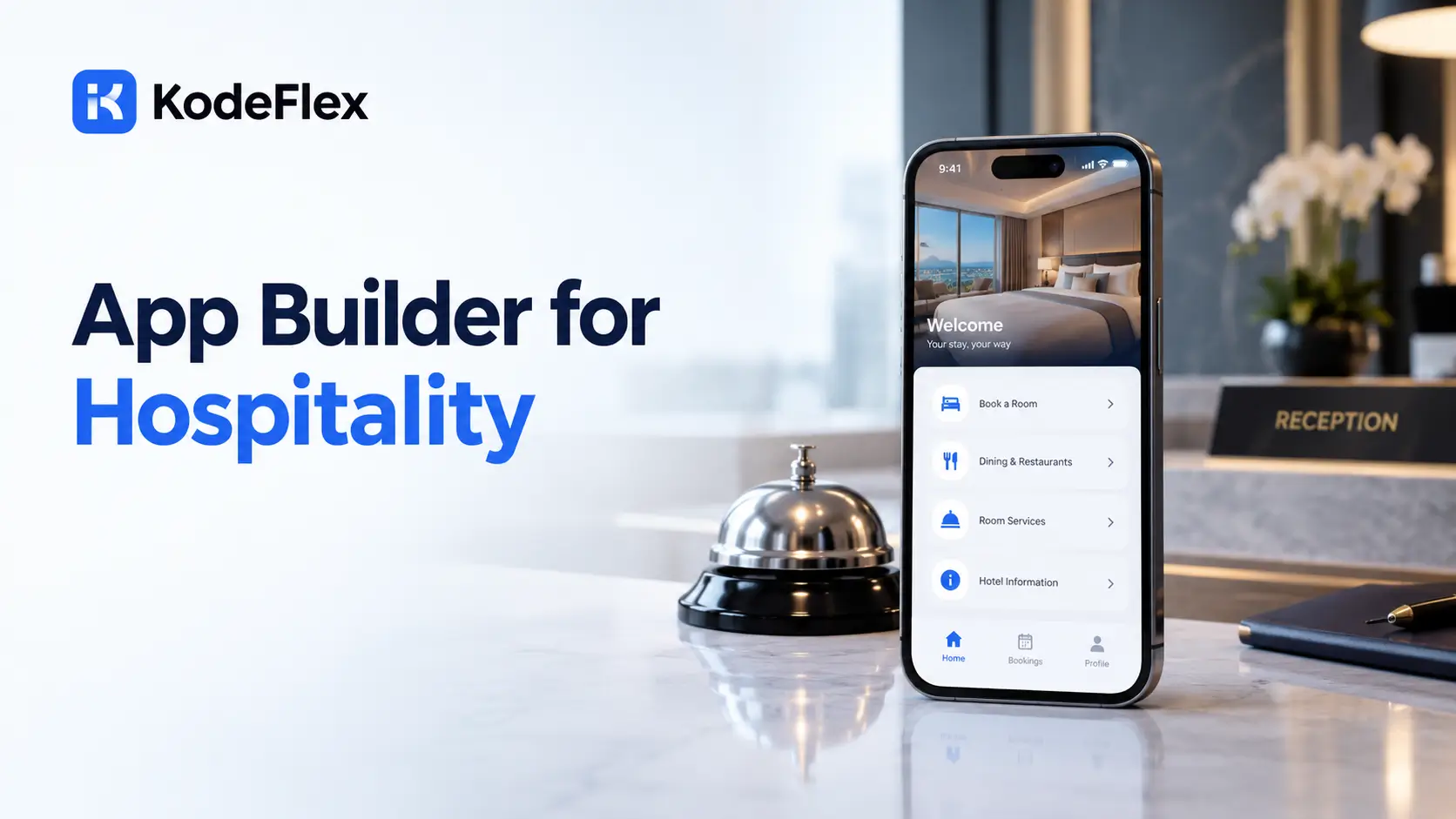
It is 7am at a hotel. Two housekeepers called in sick. The duty manager is texting people one by one, hunting for cover. Meanwhile a guest in room 412 has asked twice for an extra pillow, and the request lives on a sticky note. Sound familiar?
Most hotels and restaurants run the back of house on group chats, paper and one very loved spreadsheet. An app builder for hospitality fixes that layer. Below we look at where it helps, what to check before you pick one, and where it does not fit. Want to try it on your own process? You can see KodeFlex in action with a demo.
What is an app builder for hospitality?
It is software that turns a plain description of a process into a working internal app. You type something like "staff request shift swaps, the supervisor approves, the rota updates." The tool builds the forms, the approval steps and the screens. Then you adjust.
Developers still matter, to be fair. But the small, very specific apps that a kitchen or a front desk needs no longer wait months in an IT queue. Most of those apps are about people passing work to each other. Who asks. Who approves. Who gets told.
Worth saying plainly: this is the layer around your reservation system and your tills. Not the reservation system and the tills themselves.
Where hotels and restaurants use internal apps
Start with the work that bounces between people, shifts and departments. That is where things get lost.
|
Use case |
What the app does |
Who touches it |
|---|---|---|
|
Staff scheduling and swaps |
Staff post a swap or time off request. The supervisor approves. Everyone sees the final rota. |
Staff, supervisor, manager |
|
Housekeeping and maintenance |
Request with room, photo and priority. Goes to the right team and stays open until closed. |
Front desk, housekeeping, engineering |
|
Supplier and purchase approvals |
Spend request routes to the right approver by amount and category. |
Chef, manager, finance |
|
Guest request tracking |
Every request gets an owner, a status and a time. Nothing sits on a sticky note. |
Front desk, departments |
|
Incident logs |
Spills, complaints, injuries and near misses recorded in one place, with a follow-up task. |
Any staff, duty manager |
Staff scheduling and swap requests
Shift swaps are the classic mess. One person texts the group. Three people reply. Nobody tells the manager. A swap app gives each request a status. Staff ask, a colleague accepts, the supervisor approves. Done.
A note on scope. Your app can handle requests and approvals around the rota. Whether it replaces a full rostering tool depends on what you need, so check that on a demo.
Housekeeping and maintenance requests
A broken shower head gets reported at the desk. Then in a message. Then again in the morning meeting. With a request app, one person logs it with the room number and a photo. Engineering sees it. The room can be flagged until it is fixed.
You also get patterns. Which floor keeps having the same fault? A log shows it. A group chat hides it.
Supplier and purchase approvals
The chef needs a new fryer basket today. The owner is away. The request sits in an inbox. Set rules by amount and category, and requests find the right approver on their own. Add a backup approver for when the first one is out.
Guest request tracking
Extra towels. Late checkout. A cot for the room. These small asks decide whether a guest rates the stay well. An app gives each one an owner and a status. When a request is stuck, the duty manager sees it before the guest asks twice.
Incident logs
Something happens on shift. A guest slips. A kitchen burn. Staff write it down on paper, maybe, and maybe it gets filed. A simple incident form with a required follow-up task gives you a clean record. Check your local rules on what you must record and for how long. The app holds the record. It does not tell you what the law needs.
What to look for in an app builder for hospitality
Plenty of tools promise this. A few things separate the useful ones from the demos.
-
Approval flows that handle real rules. Amount limits, branches, backup approvers. Hotel approvals are rarely one step.
-
Roles and permissions. The front desk sees guest requests. Kitchen staff see kitchen tasks. Finance sees spend.
-
Editable output. If AI builds the first version, you must be able to change it without starting over.
-
Versioning. You will tweak the app every few weeks. You need to roll back when a tweak goes wrong.
-
Many sites, one app. A group with several hotels or restaurants wants the same app in each, with small differences.
-
Deployment choice. Some owners want data on their own servers. Ask if that is possible.
-
Honest limits. A vendor that tells you what it does not do is easier to trust.
How KodeFlex fits
KodeFlex is an AI development platform from EasySoft INC. According to the KodeFlex product page, you describe a business need in natural language and it builds a runnable app, with the frontend, backend and approval flows included. You then refine forms, actions and workflows visually.
|
Hospitality need |
What the KodeFlex pages describe |
|---|---|
|
A first version fast |
One-prompt generation of the app, with editable structured configuration. |
|
Approval rules |
Workflow orchestration for approval paths, rules and branches. |
|
Changes over time |
Version control, live preview, one-click release and deployment. |
|
Several hotels or outlets |
Multiple instances from one app, with one-click upgrades, and the option to enable or suspend an instance. |
|
Data control |
Private deployment option, so data does not have to leave your own environment. |
The KodeFlex home page lists forms, approvals and workflows among its core use cases. Cost matters too. The pricing page shows lifetime licenses from $1,499 (Team, 50 users, 20 apps) and annual licenses from $3,699. Plans change, so check the page before you plan a budget.
Where an app builder does not fit
Let's be straight about this. KodeFlex is built for internal business apps and enterprise collaboration. It is not a booking engine. It will not take reservations from guests on your website or sync room rates with online travel sites. It is not a POS either, so it does not take orders or payments at the table or the desk.
It is also not meant for consumer mobile apps or graphics-heavy products. A guest facing app for the App Store is a different job.
And some things we cannot say from the public pages. The KodeFlex site does not list specific property management or POS integrations. If your guest data lives in a particular system, ask about that on a demo before you assume anything.
An illustration: a maintenance request app for a small hotel
Picture a hotel with sixty rooms and two engineers. Faults arrive by phone, by message and by shouting across the lobby. Nobody knows what is open. (This is an illustration, not a case study.)
-
Describe it. The manager writes a short brief. Staff log a fault with room, photo and urgency. Engineering accepts it. The desk sees the status.
-
Refine it. Repairs above a set cost need the owner's approval. That is one rule in the workflow editor.
-
Test it. Housekeeping tries it for a week. They find the form needs an "affects guest stay" tick box. Added in minutes.
-
Roll out. The front desk and night team join. Engineers see their own jobs. The manager sees everything.
What changes? The engineer opens one list instead of a message thread. Housekeeping stops chasing. The desk can tell a guest when the fix is coming.
Checklist: before you build your first hospitality app
-
Pick one process that causes daily friction. Shift swaps and fault reports are safe starts.
-
Write down who asks, who approves and who gets told.
-
List the approval rules, including amounts and who covers when someone is away.
-
Name two people on shift to test it, one from the floor and one from the office.
-
Decide who can see what, by department and by site.
-
Check where your guest and booking data lives, and ask how the app should connect to it, if at all.
-
Launch to one department first. Collect complaints for two weeks.
-
Then roll out to everyone and keep a list of requested changes.
Ready to test it on your own rota or request process? See KodeFlex in action and bring your messiest workflow. You can also download KodeFlex to try it yourself.
Frequently asked questions
What is an app builder for hospitality?
It is a tool that turns a plain description of a process into a working internal app. Hotels and restaurants use it for shift swaps, housekeeping and maintenance requests, approvals and incident logs. It is for the work behind the guest experience.
Can an app builder replace my booking system or POS?
No. A booking engine takes reservations and a POS takes orders and payments, and a builder does neither. KodeFlex is for internal business apps, so it sits next to those systems and not in place of them.
Do I need developers to use one?
Not for most day to day apps. Someone who knows the process can describe it and adjust the result. For connections to other systems you may still want technical help, so ask about that early.
Can one app work across several hotels or outlets?
That is a common need. KodeFlex describes running multiple instances from a single app, with version provisioning and one-click upgrades. Ask in a demo how that would work for your sites.
Is it safe for staff and guest data?
Ask the vendor directly. KodeFlex says it offers private deployment, which keeps data in your own environment. Check security details with them before you load anything sensitive.
How long does it take to build a hospitality app?
The KodeFlex site says one prompt can produce a runnable app. A real rollout takes longer, because staff need to test it and you will change things. Plan for a pilot of a couple of weeks.
How much does KodeFlex cost?
The pricing page lists lifetime licenses from $1,499 for the Team edition (50 users and 20 apps), and annual licenses from $3,699. Plans can change, so check the page for current numbers.
|
Want an app builder for hospitality that fits your own process? Bring one workflow that keeps getting stuck between shifts or departments. We will show you how it looks as a working app. See KodeFlex in action with a demo, or look at the product page first. |
Related Blogs
RPA vs AI Agents: What Is the Real Difference?