
KodeFlex vs Softr: Two AI-Native Builders, Different Assumptions
September 7, 2026PUBLISHED INAI Development
 ali
 2026-09-07 01:19:00
 0
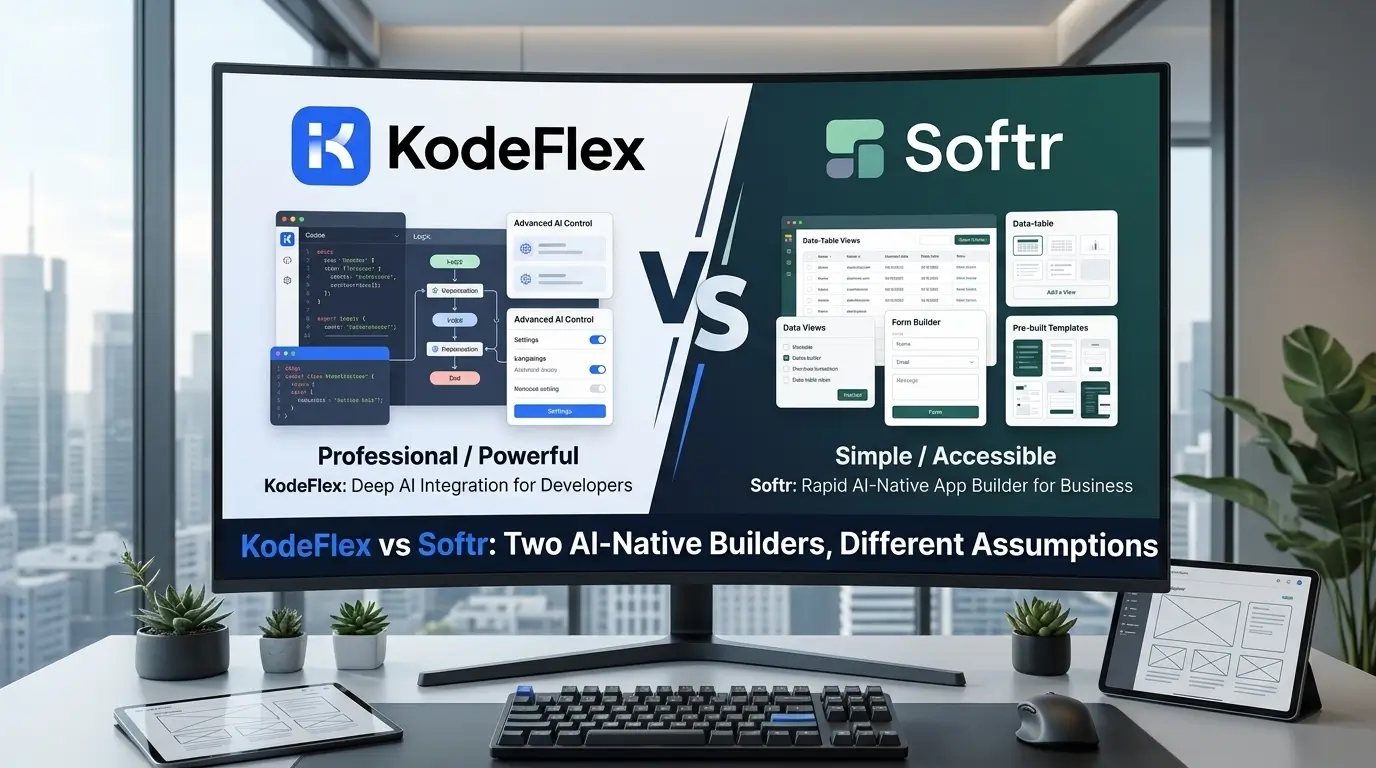
Softr started as a tool for turning Airtable data into client portals and internal apps, and for a long time that spreadsheet-first identity defined it. That's changed. Softr now ships an AI Co-Builder that generates the database, app, and business logic directly from a description, positioning it much closer to KodeFlex's approach than its earlier reputation suggests. Worth comparing them as they actually are now, not as Softr used to be.
Both Now Start From a Description
This is the headline change: Softr's AI Co-Builder means you no longer strictly need an existing spreadsheet to get started, describe what you need and it generates the database and app together, similar in spirit to how KodeFlex works. The two platforms are closer in starting philosophy today than a comparison written a year ago would have found.
Where They Still Diverge
Softr still keeps the external-data-source model as a first-class option, 15 or more integrations including Airtable, HubSpot, and SQL databases, alongside its own built-in Softr Databases (supporting up to roughly 500,000 records). That flexibility is genuinely useful if your data already lives somewhere specific. KodeFlex's workflow engine, by comparison, is built specifically around business process logic, approvals, branching, role-based routing, generated as a core part of the app rather than a feature layered on top of a general-purpose database tool.
Pricing: What Changed in August 2026
Softr updated its pricing structure on August 5, 2026, moving toward more flexible, usage-based scaling and separating Team Users from Client Users in how they're counted. The core meter remains the number of app users (team and client combined), not the number of apps, apps are unlimited on every tier including Free. Entry paid plans run roughly $19-59 a month depending on billing cycle and current promotions, scaling up as user counts grow. Given how recently this changed, confirm current figures directly on Softr's pricing page rather than relying on older reviews still describing the previous tier structure.
Feature Comparison
|
KodeFlex |
Softr |
|
|
Starting point |
AI generates the data model and app from a description |
AI Co-Builder generates database, app, and logic from a description (added 2026) |
|
What's metered |
See current pricing page |
App users (team + client combined), not number of apps, unlimited apps on every tier |
|
Entry pricing |
See current pricing page |
Free tier, paid plans roughly $19-59/mo entry, scaling with user count |
|
External data source |
Not required |
Optional, supports 15+ sources or its own built-in Softr Databases |
|
Workflow logic |
Built-in workflow engine for approvals, branching, multi-role routing |
Built-in workflow automation, metered by monthly execution limits |
Who Should Pick Which
Softr fits teams that want the option to connect an existing data source, or that need a broad integration list (Stripe, HubSpot, SQL) alongside AI generation. KodeFlex fits teams whose priority is workflow-driven business logic generated as the core of the app, particularly where approval routing and multi-role processes matter more than connecting to a specific external data source.
Straight Answers
Is Softr still primarily an Airtable tool?
Not anymore exclusively, it now supports its own built-in database alongside external sources, and generates apps via AI from a description.
What's the real cost driver on Softr?
The number of app users, team and client combined, not the number of apps you build, which are unlimited on every tier.
Did Softr's pricing recently change?
Yes, on August 5, 2026, moving to a more flexible, usage-based structure with separated team and client user counting.
Does KodeFlex support connecting external data sources like Airtable or HubSpot?
KodeFlex generates its own data structure as part of the app rather than positioning external source connections as a core feature the way Softr does.
Which is better for approval-heavy internal workflows?
KodeFlex's workflow engine is built specifically around that kind of business process logic as a core feature, not an add-on.
Want to see workflow-first app generation in action?
Visit KodeFlex or request a demo and describe the app you need.
Related Blogs
KodeFlex vs Glide: Generating an App vs Wrapping a Spreadsheet