Self-Hosted vs Cloud AI App Builder: Which Is Right for Your Enterprise?
July 14, 2026PUBLISHED INAi Development
 ali
ali 2026-07-14 14:48:00
 0
0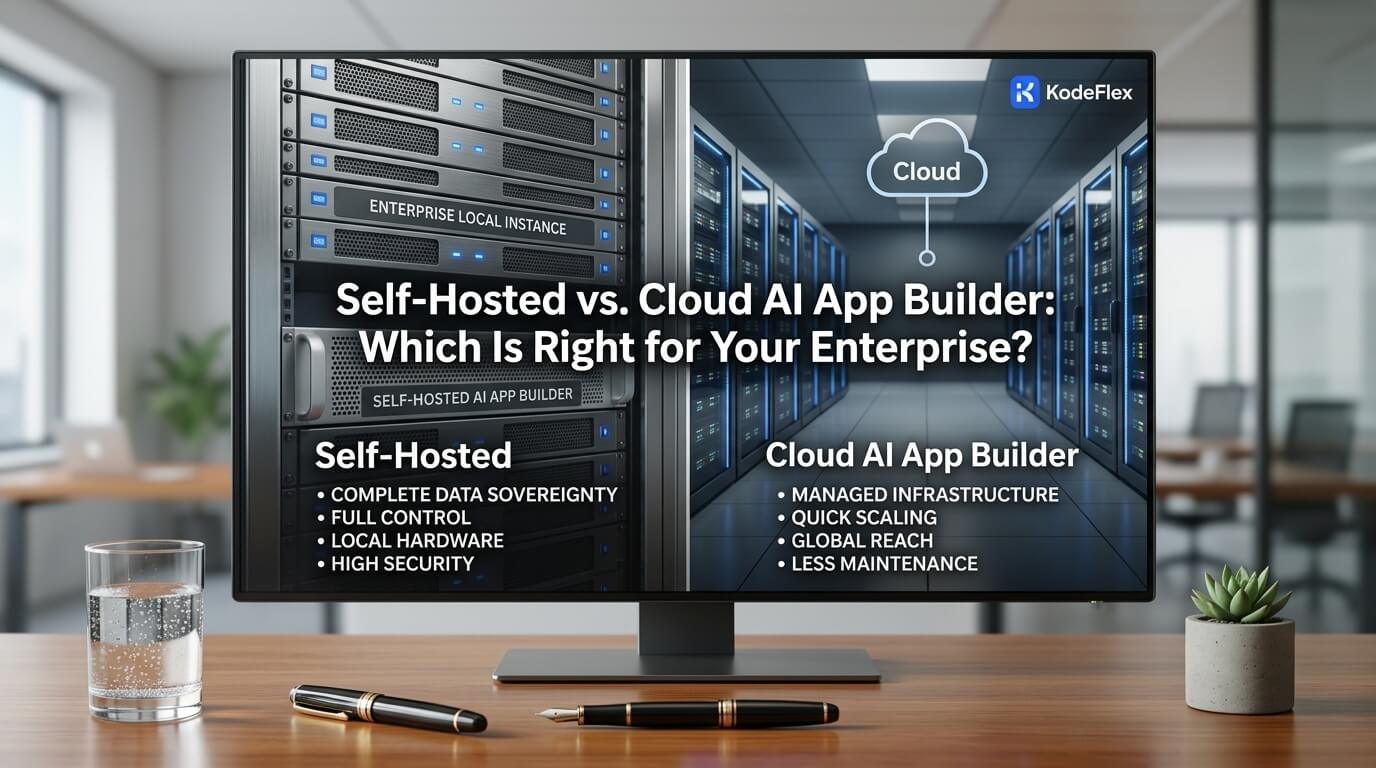
Typically, a self-hosted AI app builder is more advantageous when an enterprise is storing sensitive information, runs consistent workloads over time, and has an in-house technical staff. A cloud AI app builder will generally be more suitable if your team requires speed, experience with changing demands, or does not have a dedicated infrastructure team. The best model will depend on your situation and level of compliance exposure, workload, and internal technical capacity.
A once easy decision, but now it faces enterprises as AI-powered tools increasingly go from experimentation into production. Most AI app creators were available just a couple of years back in one form: cloud-based, subscription, and fully managed. As more platforms provide private deployment choices, it's up to IT leaders and engineering teams to choose whether to build it themselves or let a vendor handle everything for them. That decision will have an impact on data security, total cost of ownership, and the amount of overhead your team will need to bear.
This guide explains the difference between self-hosted and cloud AI app builders, when each approach is appropriate, and how to consider the choice for your enterprise context.
What is a Self-Hosted AI App Builder?
A self-hosted AI app builder is an application you can deploy and use on infrastructure that you own or have direct control over, such as on-premises servers, private data centers, and infrastructure that you lease and manage yourself. All prompts, data, and generated application logic remain on-site on the local servers.
This matters most for the layer where AI app builders differ from ordinary self-hosted software: the AI models generating your application code, and the business data those prompts often reference, never leave your network boundary. Your team is responsible for provisioning hardware, managing updates, securing the environment, and keeping the platform running — but in exchange, you get full authority over configurations, data paths, and security policy.
What Is a Cloud AI App Builder?
Cloud AI app builder is a completely hosted application that operates on a vendor's infrastructure. It's accessed via browser or API, hosted, scaled, and maintained by the vendor, and usually billed in a subscription or usage-based format. On the other hand, prompts and generated code are handled by the vendor's servers, which will lead to quicker onboarding and virtually no infrastructure management on your part—except for having to rely on the vendor's data management policies and uptime guarantees.
This is the one model that most AI app builders and enterprises find themselves in today, including many popular no-code and low-code AI vendors, as it's quicker for vendors to ship and easier for smaller teams to use without involving DevOps.
Self-Hosted vs Cloud AI App Builder: Key Differences
The lesson to be learned: trades that are self-hosted are convenient but lack control; trades that are in the cloud are controlled but slow. Neither is necessarily superior to the other; it depends on what you are optimizing your enterprise for.
When Self-Hosted Makes Sense for Your Enterprise
Self-hosted AI app builders are a better match in these situations:
-
You are in a regulated industry (healthcare, finance, government) and data residency or sovereignty considerations may limit data processing locations.
-
You have significant amounts of work and known workloads so that investing in infrastructure up front is worthwhile over time.
-
You already have an internal IT or platform engineering team to manage deployment, security, and updates.
-
Your legal or security team has flagged concerns about sending proprietary business logic or customer data through third-party servers
-
You need full architectural transparency, without relying on a vendor's black-box infrastructure decisions
Enterprises in this category are often less concerned with time-to-first-app and more concerned with long-term control, auditability, and keeping sensitive data inside a defined perimeter.
When Cloud Makes Sense for Your Enterprise
Cloud AI app developers are more likely to succeed if they:
-
Validating an idea or building an MVP, you don't want to invest in infrastructure before you test the concept.
-
Your work is unpredictable or continues to increase, and elastic scaling is more important than fixed scaling.
-
You don't have your own DevOps or infrastructure team to handle a self-hosted deployment.
-
At this point, it's better to be fast than go to great lengths to customize.
-
You'd like to get to know a platform before committing to a private deployment later on.
Not all businesses have to choose just one way for good. The cloud-based version of a platform is typically used in a first-cut fashion to get things going quickly, with individual workloads then being migrated to a self-hosted or private deployment when data sensitivity or cost at scale requires it.
Common Misconceptions About Self-Hosted vs Cloud AI App Builders
Misconception 1: "Self-hosted is always more secure."
Although you're in control of your data with self-hosting, you're still relying on the security of your team's configuration and maintenance of the environment. It may be riskier than a well-managed cloud platform offering robust enterprise security practices if the deployment is not well secured.
Misconception 2: "Cloud is always cheaper."
Cloud pricing seems easier to grasp in the beginning, but usage-based and per-seat pricing increase according to the number of seats adopted. However, self-hosted deployments often are more cost-effective after the infrastructure investment, once the sustained usage volume is high.
Misconception 3: "You have to choose one model forever."
There are now several platforms that enable hybrid deployments—hosting both non-sensitive or experimental workloads in the cloud and production or regulated workloads on private infrastructure. This is not a compromise; it's a match between each workload and the environment that is required.
Misconception 4: "Self-hosting means losing AI capability."
Self-hosted doesn't imply minimal. Just like their cloud-based counterparts, modern self-hosted AI app builders can provide the same natural-language app generation and workflow features, just where the app is generated and who manages the accompanying infrastructure.
How KodeFlex Fits Into This Decision
KodeFlex is built to remove the trade-off enterprises usually assume they have to make. It combines one-prompt AI app generation and visual workflow refinement with support for private deployment, so enterprise teams that need data control don't have to give up AI-driven speed to get it.
Because KodeFlex generates transparent, adjustable workflow configurations rather than locking logic inside a vendor's black box, teams can inspect, tune, and govern what the AI produces — a meaningful advantage for organizations that need both fast app delivery and long-term architectural control. This synergy of AI speed and deployment flexibility is the critical aspect for enterprises considering a self-hosted solution for compliance or data sensitivity reasons.
How to Choose the Right Model for Your Team
It can aid in the decision if you can answer a few direct questions:
-
Are there conditions imposed by regulatory or contractual requirements that restrict the processing of your data?
-
Is there a maintenance team within your organization that will be able to do the maintenance in a realistic way?
-
Do you have consistent and predictable workloads, or are they still changing as you work out demand?
-
How much would a data exposure incident cost your organization, financially and reputationally?
-
Would a hybrid approach — cloud for experimentation, self-hosted for production — better match how your teams actually work?
Walking through these questions with both your engineering and compliance stakeholders usually narrows the decision faster than comparing feature lists alone.
FAQs
Is a self-hosted AI app builder more secure than a cloud AI app builder?
Not automatically. Self-hosted gives you full control over where data is processed, but security still depends on how well your team configures and maintains that environment.
Which is cheaper: self-hosted or cloud AI app builders?
It depends on usage volume. Cloud is usually cheaper at low usage, while self-hosted often becomes more cost-effective once workloads are large and sustained.
Can enterprises use both self-hosted and cloud AI app builders together?
Yes. Many enterprises run a hybrid model, using cloud environments for experimentation and self-hosted infrastructure for production or regulated workloads.
Do self-hosted AI app builders require a dedicated IT team?
Generally, yes. Ongoing maintenance, security patching, and infrastructure management require internal technical capacity or a contracted equivalent.
Is KodeFlex available as a self-hosted deployment?
Yes. KodeFlex supports private deployment alongside its AI-powered app generation, letting enterprises keep sensitive data within their own infrastructure while still using natural-language app building.
Conclusion
The choice between a self-hosted or cloud AI app builder isn't really a technical one, as it is more a policy and workload decision that fits your enterprise's compliance requirements, enterprise technical resources, and workload patterns. Self-hosted control is more suitable for regulated industries and larger companies that have their own IT teams. At the same time, cloud speed and elasticity work better for fast-moving teams that don't have infrastructure overhead.
If your company seeks an AI-powered app generation that doesn't compromise data control, it may be valuable to schedule a demo with KodeFlex and experience the power of private deployment and one-prompt generation in action.
Related Blogs
Why AI Vibe Coding Isn't Enterprise-Ready: What Teams Need Instead