Enterprise App Builder for Automotive Teams: Workflow, Compliance, Traceability
July 14, 2026PUBLISHED INAi Development
 ali
ali 2026-07-14 15:16:00
 0
0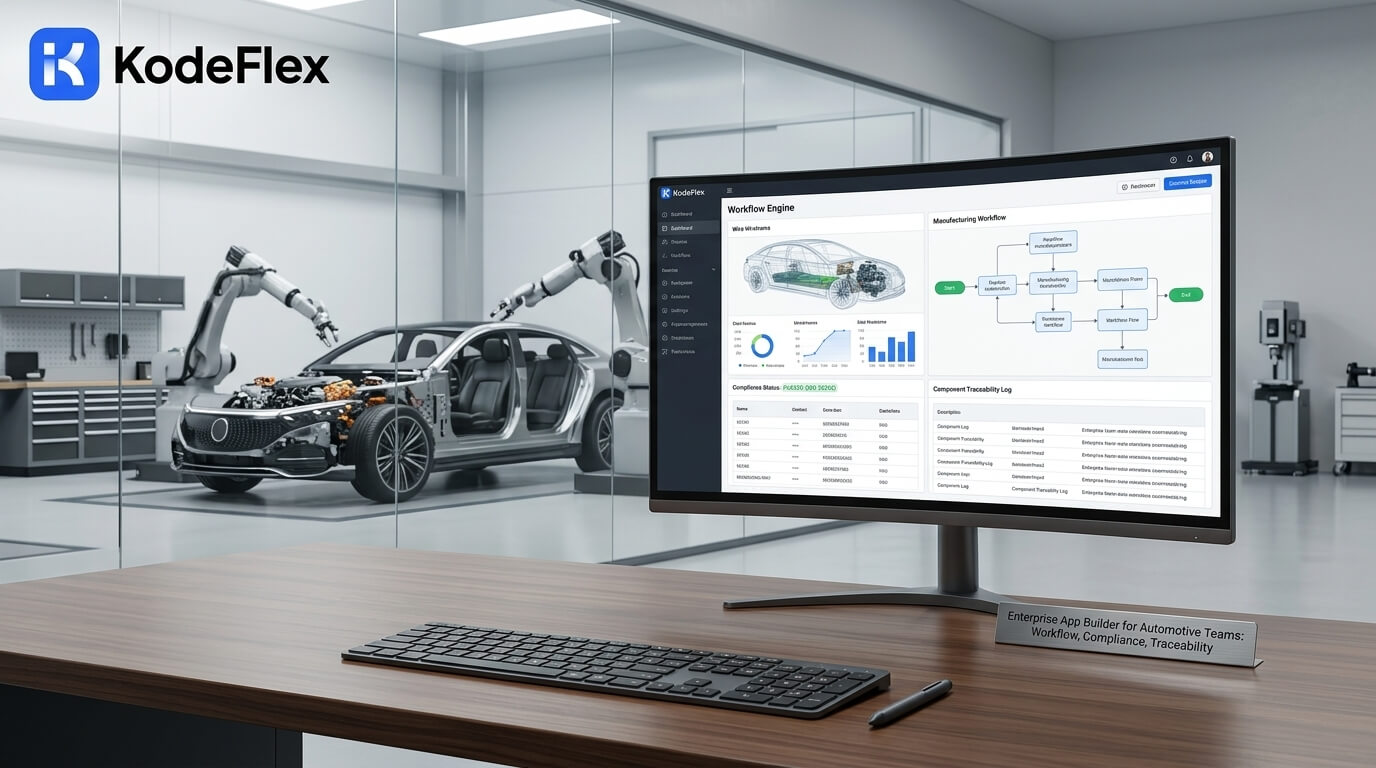
Automotive software development doesn't forgive shortcuts. Every requirement has to trace to a test. Every change has to route through an approval chain. Every audit has to produce evidence, not promises. And while general-purpose project tools and spreadsheets can limp through this for a while, they start to break down the moment a program scales past a handful of ECUs, suppliers, or safety-critical components.
This is where the conversation around enterprise app builders has shifted. Automotive OEMs and Tier 1 suppliers aren't just looking for another workflow tool—they need a way to build internal applications that are structured around ASPICE process discipline, ISO 26262 functional safety requirements, and end-to-end traceability, without waiting months for IT to hand-code a solution. That's the gap platforms like KodeFlex are built to close: AI-driven app generation paired with a real workflow engine, so automotive teams can stand up compliance-ready tools in days instead of quarters.
This guide breaks down why automotive teams need a different kind of app builder, what "workflow, compliance, and traceability" actually mean in practice, and how to evaluate a platform against those needs.
Why Automotive Teams Have Different App-Building Needs
Most industries can get away with loose, ad hoc internal tools. Automotive can't, because the process itself is regulated, audited, and tied directly to product safety. A few things make automotive app requirements structurally different:
-
Dual compliance pressure — Automotive SPICE (ASPICE) governs process maturity and capability, while ISO 26262 governs functional safety. Most software-defined vehicle programs have to satisfy both simultaneously, not one or the other.
-
Bidirectional traceability is non-negotiable — Requirements need to link forward to implementation and backward to verification evidence. This isn't a nice-to-have; assessors and safety auditors expect to see it.
-
V-model structure — Development typically follows the V-model, where requirements decomposition on one side has to mirror verification and validation activities on the other. Tools that don't reflect this structure create gaps that surface during audits.
-
Multi-party handoffs — OEMs, Tier 1s, and sometimes Tier 2 suppliers all touch the same requirements and change records. Version control and access control matter as much as the workflow logic itself.
-
Recall-level stakes — A missed traceability link or an unapproved change isn't just a process failure. It's a potential safety incident or a costly recall.
Generic project management tools weren't built with any of this in mind. That's why automotive teams increasingly look for enterprise app builders that can be configured—or generated—around their actual compliance model, not a generic Kanban board wearing a different skin.
What Is an Enterprise App Builder in the Automotive Context?
An enterprise app builder for automotive use cases is a platform that lets teams create internal applications—traceability matrices, change request systems, audit dashboards, and supplier approval workflows—without a full custom development cycle for each one.
The distinction that matters here is between the following:
-
Generic low-code/no-code platforms, which offer building blocks (forms, tables, basic automation) but leave the compliance logic entirely up to the team to design and maintain
-
Purpose-aware enterprise app builders, which can be shaped around ASPICE process groups, ISO 26262 safety lifecycle stages, and traceability requirements from the start, and adapted as standards or program scope change
For automotive teams, the second category matters more, because the cost of getting the workflow structure wrong isn't just wasted engineering time — it's audit findings.
Core Requirements: Workflow, Compliance, and Traceability
Three capabilities tend to separate a tool that actually works for automotive programs from one that just adds another disconnected system to the stack.
1. Workflow Orchestration
Automotive change management rarely follows a straight line. A design change might need review from a safety engineer, a quality lead, and a supplier contact before it's approved — and the routing logic often shifts depending on ASIL level or process area.
What this needs from a platform:
-
Multi-stage approval chains that can branch based on conditions (e.g., ASIL C/D requiring additional sign-off)
-
Change history and versioning that stays intact as requirements evolve
-
The ability to modify workflow logic when a program's process model changes, without rebuilding the whole application
2. Compliance Mapping
Compliance here isn't a checkbox — it's a demonstrable structure that maps directly to audit expectations. Teams need their internal apps to reflect the following:
-
ASPICE process areas and capability levels (CL0–CL5), so process outcomes can be evidenced during assessments
-
ISO 26262 safety lifecycle stages, including hazard analysis, safety goal definition, and verification activities tied to ASIL ratings
-
A structure that supports a single traceability matrix serving both frameworks, rather than duplicating effort across two separate systems
3. Traceability
This is the piece that most often breaks in spreadsheet-based or loosely configured systems. Effective traceability means:
-
Vertical (hierarchical) traceability — from stakeholder requirements through system and software requirements down to implementation
-
Bidirectional links — forward from requirements to test cases, and backward from verification evidence to the originating requirement
-
Audit-ready visibility — the ability to pull a complete trace on demand, not reconstruct it manually before every assessment
Together, these three pillars are really one system: a workflow that enforces the right review sequence, a compliance structure that keeps that workflow aligned to ASPICE and ISO 26262, and traceability that ties every artifact back to its source.
How KodeFlex Fits This Need
KodeFlex approaches this problem from a different angle than most low-code tools. Instead of assembling screens and connectors by hand, teams describe the workflow or tracking system they need in plain language, and KodeFlex's AI engine generates the structure — data model, approval logic, access rules, and interface — as a working application.
For automotive teams specifically, a few aspects of this matter:
-
Fast iteration when process requirements change. ASPICE capability targets, supplier requirements, or safety review structures shift over a program's life. Rebuilding a traceability app from scratch every time isn't realistic. KodeFlex's approach lets teams describe the change and regenerate the relevant workflow, rather than manually reworking screens and logic.
-
Built-in workflow engine for approval complexity. Multi-stage, condition-based approval chains — the kind ASIL-driven review processes require — are handled natively rather than bolted on through a separate automation layer.
-
Private deployment for sensitive program data. OEM and Tier 1 program data is frequently subject to strict data residency and confidentiality requirements. Private deployment options keep that data off shared public infrastructure.
-
One system instead of a patchwork. Rather than stitching together a PM tool, a spreadsheet-based traceability matrix, and a separate approval tool, teams can consolidate these into applications generated on one platform.
None of this replaces dedicated ALM tools built specifically for automotive functional safety work in large, mature programs. But for teams that need to stand up compliance-aligned workflow apps quickly — supplier onboarding trackers, internal audit-prep dashboards, change request systems — an AI-driven builder like KodeFlex removes a significant chunk of the build time that traditional development or heavier low-code configuration would otherwise require.
KodeFlex vs. the Traditional Approach
Who Should Use This
This approach is most relevant for:
-
OEM program and quality teams managing supplier compliance tracking and internal audit prep
-
Tier 1 and Tier 2 suppliers who need to demonstrate ASPICE capability and ISO 26262 traceability to OEM customers
-
Functional safety engineers coordinating hazard analysis, safety goals, and verification evidence across teams
-
IT and operations teams are tasked with reducing the number of disconnected tools used to manage compliance workflows
FAQs
Can an AI app builder actually meet ASPICE and ISO 26262 traceability requirements?
It can support the traceability structure — linking requirements, work products, and verification evidence — but the underlying process discipline still comes from the team. The tool needs to make that structure fast to build and easy to maintain.
Is KodeFlex a replacement for dedicated automotive ALM tools?
For large, mature safety-critical programs, dedicated ALM platforms often remain necessary. KodeFlex is better suited to building the surrounding workflow apps — approval chains, tracking dashboards, and supplier portals—quickly and without a full dev cycle.
Why does private deployment matter for automotive compliance apps?
OEM and supplier program data is often governed by strict confidentiality and data residency requirements. Private deployment keeps sensitive requirements, safety cases, and supplier data off shared public cloud infrastructure.
How is this different from a general-purpose low-code platform?
General low-code tools give you building blocks but leave compliance structure entirely up to your team to design. Purpose-aware platforms can be shaped around ASPICE process groups and ISO 26262 lifecycle stages from the outset.
What happens when compliance requirements or program scope change?
With an AI-driven builder, teams can describe the change and regenerate the affected workflow, rather than manually rebuilding screens, forms, and logic each time a standard or process shifts.
Conclusion
Automotive software programs don't have room for tools that treat compliance as an afterthought. Workflow, compliance mapping, and traceability aren't separate concerns — they're one connected system, and the platforms that support automotive teams well are the ones that reflect that from the ground up.
KodeFlex's AI-first approach won't replace deep, specialized ALM systems for the most safety-critical, large-scale programs. But for teams that need to move fast — standing up approval workflows, traceability dashboards, and supplier tracking apps without a lengthy build cycle — it offers a way to get there without adding another disconnected tool to the stack. If your team is evaluating how to build compliance-ready internal apps faster, book a demo with KodeFlex and see how a single prompt can turn a process requirement into a working application.
Related Blogs

Self-Hosted vs Cloud AI App Builder: Which Is Right for Your Enterprise?