Legacy Application Modernization With AI: A Practical Guide
July 30, 2026PUBLISHED INAi Development
 ali
ali 2026-07-30 12:42:00
 0
0
AI has changed the economics of legacy modernization by attacking its most expensive phase — understanding the system — rather than the coding phase everyone focuses on. AI tools deliver measured productivity gains of roughly 25–40% on refactoring and comprehension tasks, but they do not make a full rewrite safe. The practical approach is incremental: use AI for archaeology, documentation, and test generation; use a strangler-fig pattern for delivery; and replace peripheral workflow applications with generated apps before touching the core.
The pressure that makes 2026 different
Legacy modernization has been a permanent agenda item for twenty years. Three things changed its urgency:
Maintenance is consuming the budget. Gartner analysis has put legacy system maintenance at 60–80% of IT spend in traditional enterprises, and Deloitte's earlier work found organisations spending roughly 55% of IT budgets maintaining outdated systems. generated appsIn financial services, COBOL-based platforms have been reported to consume 70–75% of annual IT spending. That leaves very little for anything new.
The people who understand the systems are leaving. Roughly 220 billion lines of COBOL remain in production. The average COBOL programmer is around 55 years old and approximately 10% retire annually, with nearly a third expected to have retired by 2030. This is a demographic constraint, not a hiring problem — the supply does not exist to be hired.
AI adoption requires architectures legacy systems cannot provide. You cannot expose a batch-oriented monolith to an AI agent that expects APIs, real-time state, and structured data. Modernization has moved from cost reduction to capability prerequisite.
The scale of accumulated technical debt gives the context: CAST Software analysis suggests eliminating global technical debt would require an estimated 61 billion workdays, with nearly 45% of enterprise code considered fragile or high-risk to modify.
The decision matrix: seven options, not two
The framing that wrecks modernization programmes is "rewrite or leave it alone." There are seven options and most systems need different ones.
The under-used option is Replace. A meaningful share of what runs on legacy systems is not differentiating business logic — it is requisitions, approvals, registers, requests, and trackers. Those do not need modernizing. They need replacing with a generated workflow application, in days, freeing the modernization budget for the genuinely hard parts.
Rehosting costs have been benchmarked at roughly $800–$1,500 per function point and refactoring at $1,200–$3,500. Every function point you can retire by replacing rather than migrating is money not spent.
Where AI genuinely helps
Code archaeology — the highest-value application. The dominant cost in modernizing a large system is not writing new code; it is understanding the existing code well enough to change it safely. A typical 2026 modernization target is a Java monolith of 1–3 million lines accumulated over 10–15 years with test coverage below 25%. AI models read that code faster than any human and produce useful explanations of what a 400-line method does, what a stored procedure touches, and which paths are dead.
Documentation generation. Legacy systems are under-documented by definition. AI can produce first-draft documentation at a scale that was never economically viable before — module summaries, data-flow descriptions, integration inventories. It will be imperfect. Imperfect documentation of a previously undocumented system is still a large gain.
Test generation before change. This is the highest-leverage step and the one most often skipped. You cannot safely refactor a system with 25% test coverage. AI-generated characterisation tests — tests that capture what the system currently does rather than what it should do — create the safety net that makes incremental change possible. Generate tests before you change anything.
Mechanical translation with human verification. AI-assisted COBOL-to-Java conversion works when it is treated as a first draft requiring architectural review and test-gating at every step, not as an automated pipeline. Practitioners working this way pair agentic AI tools with senior architectural oversight, where AI handles automated analysis and conversion and consultants validate business logic and test-gate each stage.
Dependency and impact mapping. "If we change this, what breaks?" is the question that stalls modernization. AI-assisted static analysis across a large codebase answers it faster than manual tracing.
Measured productivity improvement on refactoring tasks using AI IDE assistants sits at roughly 25–40%. That is a real gain. It is not a 10x transformation, and any vendor claiming otherwise should be asked for the measurement methodology.
Where AI fails, and what it costs when you trust it
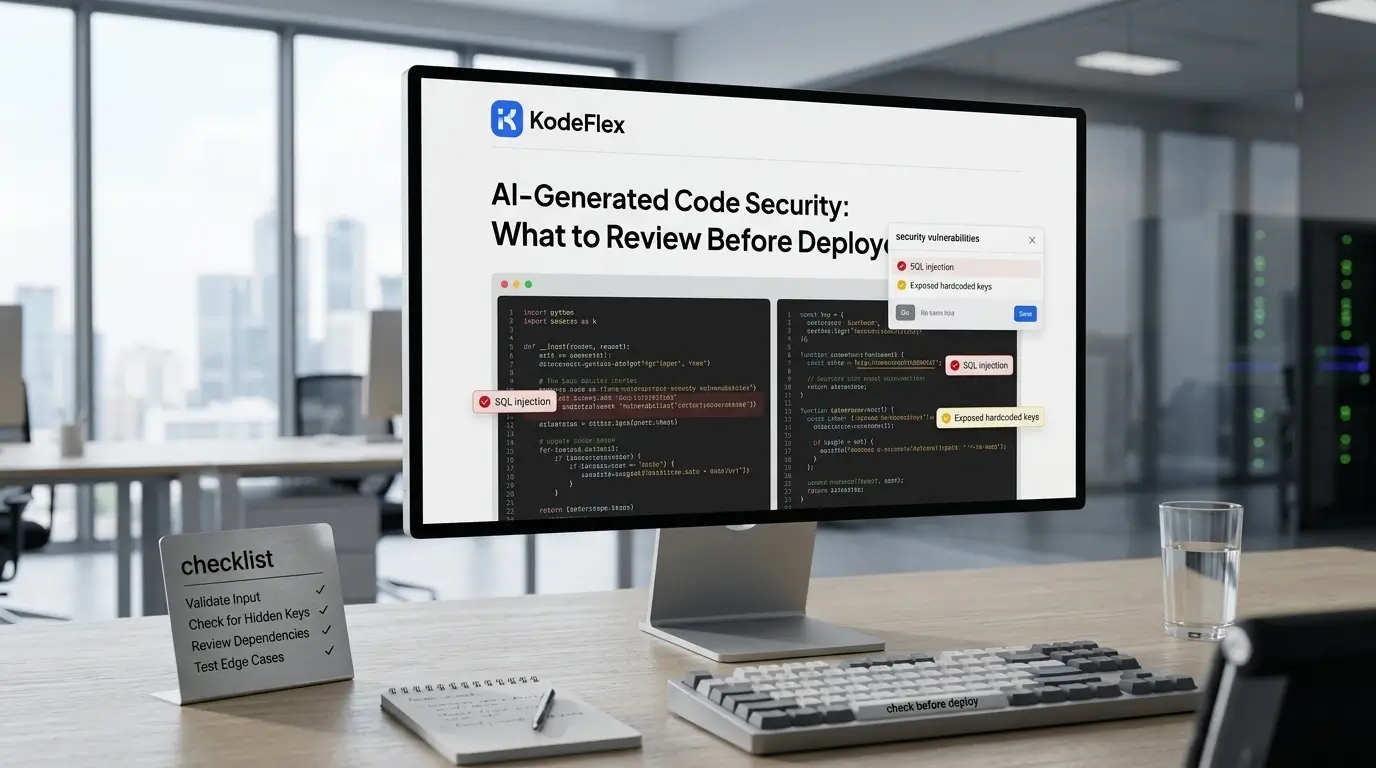
It does not know your business rules. A COBOL routine contains a 1997 regulatory exception nobody documented. AI translates the code correctly and has no idea the rule was repealed in 2011 and the branch is now wrong. Faithful translation of an obsolete rule is a defect.It generates confident, insecure code. Independent 2026 studies put vulnerability rates in AI-generated code between 25% and 45%. Modernization output must go through the same security review as any generated code — arguably more, since it is handling systems of record. See AI-Generated Code Security for the review checklist.
It cannot make architectural judgements. Where service boundaries belong is a question about organisational structure, transaction consistency requirements, and change frequency. AI will propose a decomposition. It will not know that two of those services are owned by teams that never coordinate.
It amplifies the big-rewrite temptation. This is the most dangerous failure. When generation feels cheap, full rewrites look feasible again. They are not — the constraint was never typing speed. McKinsey's Rewired research found that companies modernizing incrementally recover their investment roughly three times faster than those attempting full rewrites, and incremental refactoring carries the lowest failure rate of the high-effort approaches.
A phased roadmap
Inventory and triage (2–4 weeks). Catalogue every application: business criticality, change frequency, maintenance cost, technical risk, and who understands it. Apply Gartner's TIME framework — Tolerate, Invest, Migrate, Eliminate. Most portfolios contain applications nobody has used in two years. Eliminate those first; it is free.
Replace the periphery (4–8 weeks). Identify non-differentiating workflow applications on the legacy estate: approvals, registers, requests, trackers. Replace them with generated applications rather than migrating them. This delivers visible wins in the first quarter, builds organisational confidence, and reduces the surface area of the hard migration. On a platform like KodeFlex, each of these is a days-long build with private deployment, so the replacement runs inside the same perimeter as the system it is leaving.
Understand the core (6–12 weeks). Point AI comprehension tooling at the systems you must keep. Produce documentation, dependency maps, and — critically — characterisation tests. Ship nothing in this phase. Resist the pressure to.
Strangle incrementally (ongoing). Apply the strangler fig pattern described by Martin Fowler: build new capability alongside the legacy system, route traffic to it incrementally, retire legacy components one at a time. Each increment is independently valuable and independently reversible. There is no big-bang cutover date to miss.
Retire and verify. Decommission properly. Confirm nothing still calls the old system, archive the data with a defined retention period, and record the actual cost saved. Undocumented decommissioning is how organisations end up paying for systems nobody uses.
The metric that keeps the programme honest
Most modernization programmes report progress as percentage of code migrated. That measures activity, not value.
Report instead:
• Maintenance spend as a share of IT budget — the number modernization exists to move
• Function points retired versus migrated — retiring is cheaper than migrating; reward it
• Change lead time on modernized components versus legacy equivalents
• Number of systems with fewer than three people who understand them — your key-person risk, trending down
If the first metric is not falling after twelve months, the programme is moving code rather than reducing cost.
FAQ
What is legacy application modernization?
Legacy application modernization is the process of updating, replacing, or re-architecting outdated software systems so they align with current business and technical requirements. It spans seven approaches — retain, rehost, replatform, refactor, rearchitect, rebuild, and replace — and most application portfolios need a different approach for different systems.
How does AI help with legacy modernization?
AI is most valuable for comprehension rather than code generation: explaining undocumented legacy code, generating first-draft documentation, producing characterisation tests before refactoring, mapping dependencies, and assisting mechanical language translation. Measured productivity improvement on refactoring tasks with AI IDE assistants is roughly 25–40%.
Can AI convert COBOL to Java automatically?
Not reliably as an unsupervised pipeline. AI-assisted conversion works when treated as a first draft with senior architectural oversight and test-gating at every step. The core problem is that AI translates code faithfully without knowing which encoded business rules are obsolete, so correct translation can still produce incorrect behaviour.
Should I rewrite or refactor a legacy application?
Refactor incrementally in most cases. McKinsey research found companies modernizing incrementally recover their investment roughly three times faster than those attempting full rewrites, and incremental refactoring has the lowest failure rate among high-effort approaches. Full rebuilds are justified mainly when the business logic itself is obsolete.
How much does legacy modernization cost?
Benchmarks put rehosting at roughly $800–$1,500 per function point and refactoring at $1,200–$3,500 per function point. Context matters more than the unit cost: legacy maintenance already consumes 60–80% of IT budgets in traditional enterprises, so the comparison is against an existing spend, not against zero.
What should I modernize first?
Eliminate unused applications, then replace non-differentiating workflow applications — approvals, registers, requests, trackers — with generated apps rather than migrating them. This delivers results within a quarter and shrinks the scope of the hard migration before you commit budget to the core systems.
Related Blogs
Enterprise App Development Statistics and Trends 2026