How to Build an Employee Onboarding App Without a Developer
July 31, 2026PUBLISHED INAi Development
 ali
ali 2026-07-31 13:57:00
 0
0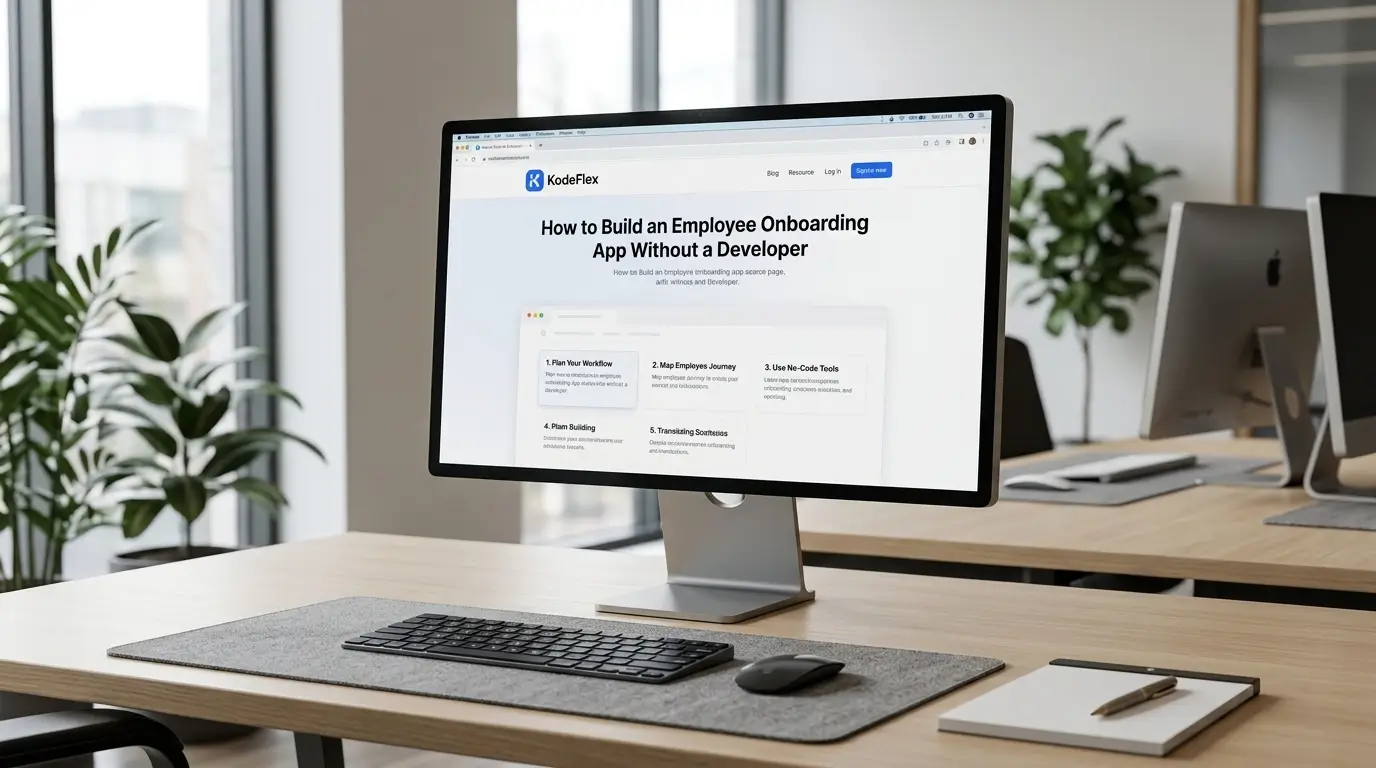
You can build a working employee onboarding app without a developer in about two to five working days. The build has four parts: define the data model (one main record per hire plus sub-tables for tasks and equipment), map the six onboarding stages, configure approval routing for HR and IT, then deploy to a test instance before production.
An AI application builder generates the first working version from a written requirement; you refine the workflow visually from there.
Why onboarding is the right first app to build
Onboarding is the highest-value candidate for a first internal app, for four reasons:
-
The process already exists. You are digitising something documented, not inventing it. That removes the hardest part of internal app projects — requirements discovery.
-
The pain is measurable. Missed provisioning, a laptop that arrives on day four, an unsigned policy document. Everyone can name a failure from the last quarter.
-
It is approval-shaped. Onboarding is a sequence of handoffs with sign-offs. That is exactly what workflow engines do well and what spreadsheets do badly.
-
It is bounded. A new hire record has maybe 25 fields. You are not modelling an ERP.
The failure mode to avoid: building "an onboarding app" as an undefined blob. Build the pre-boarding through day-30 sequence specifically, and leave performance reviews, training catalogues, and offboarding for separate modules.
Define the data model before you touch a builder
Every internal app is a data model wearing a user interface. Get this right and the rest is configuration.
Map the six onboarding stages
Each stage transition should be a state change on the main record, not a manual status update. When every provisioning task reaches Complete, the record advances to Day One automatically and notifies the manager. That single automation removes most of the chasing.
Configure approval routing
Onboarding needs three distinct approval patterns. A builder that only supports linear approval will force workarounds on all three.
Sequential approval — HR reviews the record, then IT provisioning begins. Stage 3 cannot start until stage 2 approval completes.
Conditional branching — route by attribute. A contractor skips payroll enrolment but adds an NDA step. A hire above a salary threshold routes to an additional executive sign-off. A remote hire triggers a shipping workflow instead of a desk assignment.
Parallel approval with countersigning — security clearance for a finance or engineering role may need both the hiring manager and the security lead. Joint signing means both must approve; countersigning means either approval suffices. Get this distinction right — it is where compliance audits find gaps.
In KodeFlex, these are configured visually: approval nodes with named approvers and CC recipients, conditional branches on field criteria, and a choice between joint-signature and countersignature mode per node. One-click approval generation creates the underlying approval fields and actions so you are configuring routing rather than building the mechanism.
Handle the sensitive-data problem
Onboarding records concentrate exactly the data your security team worries about: government identifiers, salary, home address, right-to-work documentation, background check results.
Three controls are non-negotiable:
Field-level permissions. The hiring manager needs the start date and the equipment list. The hiring manager does not need the salary band or the background check attachment. Role-based visibility must operate at field level, not just record level.
Deployment location. If you operate under GDPR, sectoral regulation, or a data residency policy, the app should run where your other HR data runs. Private deployment removes the entire cross-border transfer question rather than answering it — which is why on-premises capability is a gating requirement for HR apps in most regulated organisations.
Retention and audit. Every field change needs an actor, a timestamp, and a prior value. When someone asks in eleven months who approved a provisioning exception, the answer must be in the system, not in a Slack thread.
Build, test, and deploy
Generate the first version. With an AI application builder, describe the requirement in plain language: the record structure, the two sub-tables, the six stages, and the approval rules. The platform produces a runnable application — forms, list views, detail pages, and back-end logic — in minutes. This is your starting point, not your finished product.
Refine visually. Adjust field types, add validation rules (start date cannot precede offer acceptance), configure trigger conditions, add reminder settings for overdue tasks, and set up filter tags so HR can view "starting this week" and "blocked" without building reports.
Test with real data in an isolated instance. Run three past hires through the app end to end: a straightforward permanent hire, a contractor, and one where the start date moved. The third will find your bugs.
Deploy to production as a separate instance. Development, test, and production should be fully isolated instances of the same application, so a configuration change under test cannot touch live employee records. Platforms with multi-instance management let you deploy any released version to a new instance and upgrade instances individually.
Realistic timeline
Compare that to a traditional build: requirements gathering, design, sprint planning, development, QA, and UAT across multiple roles, typically six to twelve weeks.
Build versus buy: when a dedicated HR suite is the better answer
Building is the right call when your onboarding process has organisation-specific approval logic, when you need it running on your own infrastructure, or when a full HRIS is disproportionate to a 60-person company.
Buying a suite like BambooHR or Workday is the right call when you need integrated payroll, benefits administration, performance management, and statutory reporting as one system of record. Many organisations do both: the HRIS is the system of record, and a purpose-built app runs the operational onboarding sequence and writes back the outcome.
FAQs
Can I build an employee onboarding app without a developer?
Yes. Onboarding is a form-and-approval workflow, which is the application class no-code and AI-generation platforms handle most reliably. A non-technical HR or operations lead can build a production-ready onboarding app in two to five working days, provided the platform supports conditional branching and multi-approver sign-off.
How long does it take to build an employee onboarding app?
Two to five working days on an AI application builder: roughly half a day mapping the process, under an hour generating the first version, one to two days configuring workflow and approvals, and a day testing and deploying. A traditional custom build for the same scope typically runs six to twelve weeks.
What should an employee onboarding app include?
A new hire record with identity, position, dates, and compliance fields; a tasks sub-table with role-based owners and due dates offset from the start date; an equipment and access sub-table; six stage transitions from offer acceptance to day-30 check-in; approval routing for HR and IT; and field-level permissions protecting salary and identity documents.
Should onboarding data be stored on-premises?
If you operate under GDPR, sectoral data regulation, or an internal data residency policy, yes. Onboarding records concentrate personal identifiers, compensation, and right-to-work documentation. Private deployment removes cross-border transfer and third-party processor questions rather than requiring you to answer them.
How is an onboarding app different from an onboarding checklist?
A checklist records intent; an app enforces it. An app assigns owners, escalates overdue tasks, blocks stage advancement until prerequisites complete, routes approvals conditionally, and produces an audit trail. A checklist does none of these and cannot tell you which of eleven in-flight hires is currently blocked.
Can the app handle contractors and remote hires differently?
Yes, through conditional branching on the employment type and location fields. Contractors can skip payroll enrolment and add an NDA step; remote hires can trigger an equipment shipping workflow instead of a desk assignment. This is configuration, not custom code, on any platform built over a real workflow engine.
Conclusion
Building an employee onboarding app doesn't require months of custom development or a large engineering team. By defining a clear data model, automating approval routing, mapping each onboarding stage, and applying secure access controls, organizations can create a reliable onboarding process that improves employee experience and operational efficiency. With an AI application builder, you can launch a scalable onboarding solution in just a few days, streamline collaboration between HR and IT, reduce manual work, and ensure every new hire follows a consistent, compliant onboarding journey.
Related Blogs
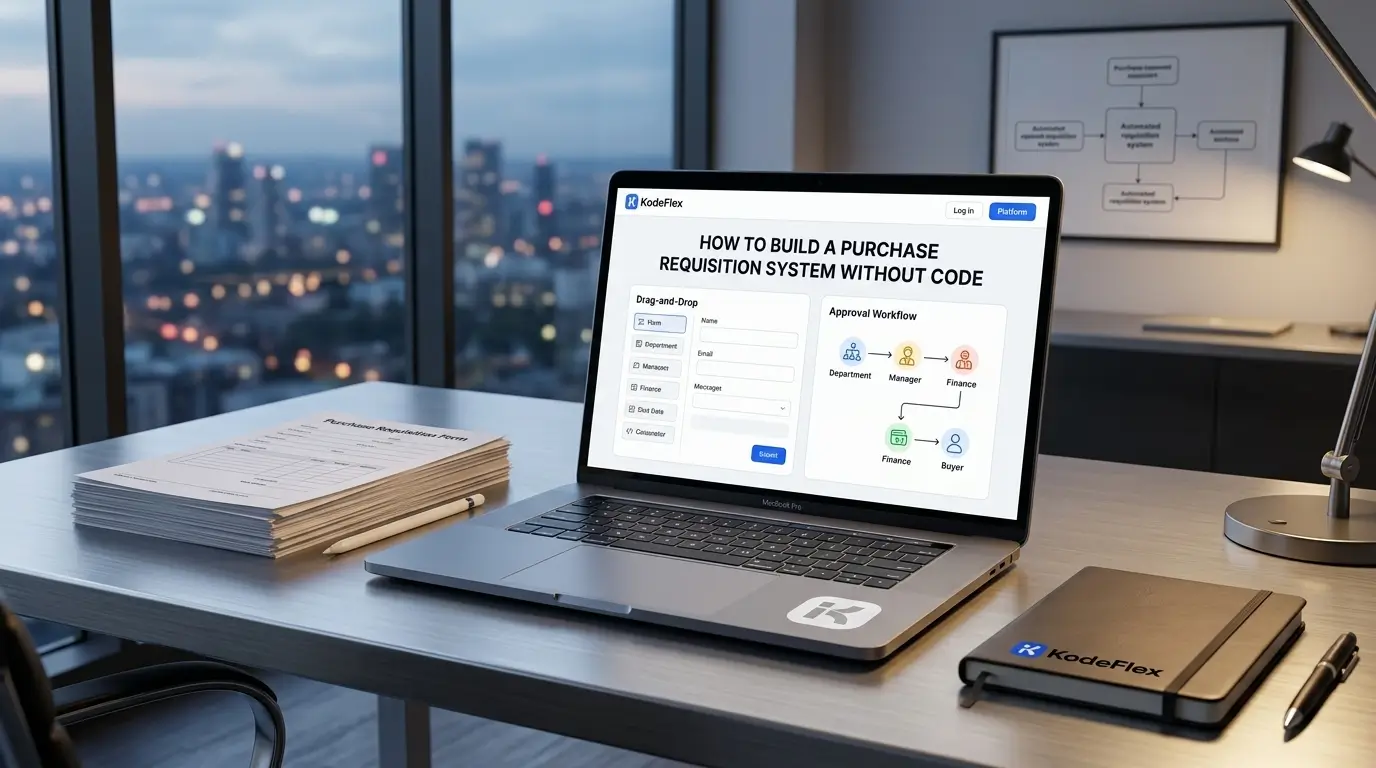
How to Build a Purchase Requisition System Without Code