Low-Code Pricing Models: The Real Cost of Per-App Licensing
July 31, 2026PUBLISHED INAi Development
 ali
ali 2026-07-31 14:30:00
 0
0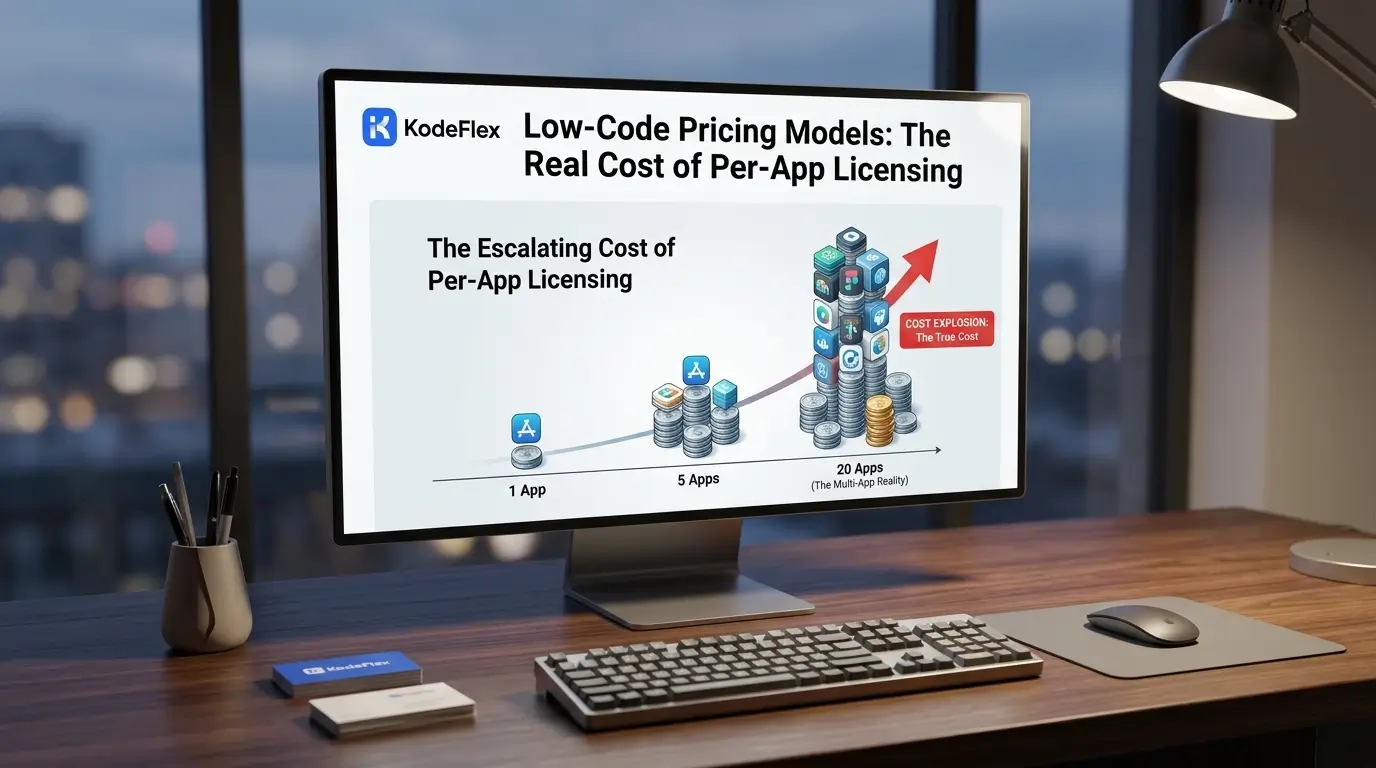
Low-code platforms bill in four ways — per user, per app, per unit of consumption, or as a flat edition licence. Per-app licensing looks cheap at one or two applications and becomes the most expensive model in the market at scale, because the metric you are billed on is exactly the metric that grows when the platform succeeds. As of 2026, enterprise no-code pricing commonly runs $15–$60 per user per month, while app-based tiers at some vendors begin near $800 per month per application.
The four pricing models, and what each one punishes
Every low-code contract reduces to one of four billing metrics. Each has a failure mode.
The pattern is uncomfortable but consistent: three of the four models bill you more for using the platform more effectively. A per-app model turns every new internal app into a budget conversation, which is precisely the friction low-code was bought to remove.
What per-app licensing actually costs
Per-app pricing is quoted per application per month. The math is simple until it isn't.
At $800 per application per month:
By year two of a typical deployment, organisations often have 15 to 50 applications built on the platform. That is not a warning about waste — it is what success looks like. A department that builds a requisition app, an onboarding app, an asset register, a leave tracker, an incident log, a vendor onboarding flow, and a change request form has built seven genuinely useful applications and created a six-figure annual line item.
The compounding problem: migrating away from a deeply embedded low-code platform is expensive, and vendors know it. Switching costs create leverage at renewal, and organisations frequently accept above-market renewal pricing because migration costs more than the increase.
The Power Apps licensing reset of 2026
Microsoft's changes are the clearest recent illustration of licensing-model risk.
The Per App subscription plan at $5 per user per app per month was removed from Microsoft's licensing guide in January 2026 and is no longer available to most new customers through MPSA or new non-CSP channels. EA customers can renew existing Per App licences; CSP availability was restored in April 2026.
The two current production paths, as of mid-2026:
• Power Apps Premium — $20 per user per month, covering unlimited Power Apps and Power Pages for that user. An enterprise tier at approximately $12 per user per month applies at 2,000+ seats.
• Pay-As-You-Go — $10 per active user per app per month via an Azure subscription, billed only for unique users who open an app at least once in a given month.
For a 300-person organisation where every employee touches one app, Premium costs $72,000 per year. Pay-As-You-Go for that same single-app scenario costs $36,000 per year. For a 60-person team using five apps each, Premium costs $14,400 while Pay-As-You-Go costs $36,000. Neither model is universally cheaper — the crossover depends entirely on your apps-per-user ratio. Model both before committing.
Complexity-based pricing: the least predictable model
OutSystems prices on Application Objects, a measure of application complexity. Entry contracts are reported to start around $36,300 per year. The consequence is structural: a more complex app with more screens, APIs, and database tables can push you into a higher tier even with the same user count.
Mendix uses capacity units bundled by application complexity. In typical deployments, capacity unit consumption grows 15–30% annually as new applications ship and user bases expand — so renewal pricing rises without any change to list price.
This creates an incentive that runs against good software practice. Under complexity-based billing, adding validation, an audit log, or a second approval branch has a direct licence cost. Teams start under-building to stay in tier.
The five costs that appear after signature
Sticker price is not the contract. These five items are consistently the gap between the quote and the it. KodeFlex's annual editions list support and updates at $739–$999 per year after year one; enterprise vendors commonly price support as a percentage of licence value.Invoice:
-
Premium connectors. Standard connectors are often seeded; anything touching an external database, an ERP, or a custom API typically requires a premium licence tier for every user who touches that app.
-
Data platform consumption. Dataverse capacity, storage overages, and log retention are billed separately from seats.
-
Environment charges. Separate development, test, and production environments are frequently metered individually. Teams running proper release discipline pay three times for it.
-
Implementation and configuration services. Budget the professional services rate. KodeFlex, for example, publishes process configuration at $369 per person-day; most enterprise vendors quote considerably higher and do not publish at all.
-
Support and update entitlements. On annual models, first-year support is often bundled and years two and three are no
Perpetual versus subscription: the CAPEX argument
Subscription pricing dominates because it suits vendors — predictable recurring revenue and renewal leverage. But for internal tools specifically, the argument for a perpetual licence is stronger than for most software categories:
• Internal tools are not customer-facing, so competitive feature velocity matters less
• The applications you build are infrastructure you depend on, and losing access when a contract lapses is an unacceptable operational risk
• Internal app portfolios grow monotonically — you rarely retire as many as you add
As of July 2026, KodeFlex publishes lifetime editions at $1,499 (Team, 50 users / 20 apps), $2,499 (Professional, 120 users / 50 apps), and $3,199 (Enterprise, unlimited users / unlimited apps), each including installation, upgrade, and migration services. Annual editions run $3,699 / $5,199 / $5,899 with first-year support included.
The comparison that matters: at 200 users and 12 applications over three years, a $20/user/month per-seat model costs roughly $144,000 and an $800/app/month model costs roughly $345,000. A flat Enterprise licence at $3,199 plus, say, twenty person-days of configuration services at $369 comes to roughly $10,579. Those are different orders of magnitude, and the difference is not feature parity — it is billing philosophy.
How to evaluate low-code pricing without getting caught
-
Build a three-scenario model, not a single quote. Price the platform at today's numbers, at 3× users, and at 3× apps. Vendors will quote the first. The second and third are what you will actually live in.
-
Ask for the metering definition in writing. "Active user" means different things at different vendors. So does "application." At complexity-priced vendors, ask exactly what counts as an Application Object or capacity unit and what triggers a tier change.
-
Price the exit. Ask what happens to running applications if you stop paying. If the answer is "they stop," you are not licensing software — you are renting the continued existence of your own business processes.
-
Separate licence cost from delivery cost. A cheap licence with a $2,000/day implementation partner is not cheap. A higher licence with published $369/person-day configuration is often the lower total.
-
Count environments. If dev, test, and prod
-
uction are billed separately, triple the relevant line before comparing.
FAQs
How much do low-code platforms cost in 2026?
Enterprise no-code and low-code pricing commonly runs $15–$60 per user per month for per-seat models. App-based tiers at some vendors begin near $800 per month per application, and complexity-priced enterprise contracts such as OutSystems are reported to start around $36,300 per year. Flat perpetual editions run from roughly $1,500 to $3,200 one-time.
What is per-app licensing?
Per-app licensing charges a recurring fee for each deployed application rather than for each user. It is predictable when you run one or two applications and becomes the most expensive model at scale, because cost scales with the number of business problems you solve.
Is the Power Apps Per App plan still available?
Not for most new customers. Microsoft removed the $5 per user per app per month Per App subscription plan from its licensing guide in January 2026. Existing EA customers can renew, CSP channel availability was restored in April 2026, and new customers are directed to Power Apps Premium or Pay-As-You-Go.
Which low-code pricing model is cheapest?
It depends entirely on your apps-per-user ratio. Per-user models are cheapest when few people use many apps. Per-app and consumption models are cheapest when many people use one app. Flat edition licences are cheapest at scale in both dimensions but cap you at the edition's user and app ceiling.
What hidden costs should I budget for?
Premium connectors, data platform consumption such as Dataverse capacity, separate charges for development and test environments, implementation and configuration services, and post-year-one support and update entitlements.
Is a perpetual licence better than a subscription for internal tools?
For internal tools specifically, perpetual licensing carries a strong argument: the applications become operational infrastructure, and a lapsed subscription means losing access to processes the business depends on. Subscription is more defensible where you need continuous major-version feature delivery.
Conclusion
Choosing the right low-code pricing model is about more than comparing monthly licence fees. Per-user, per-app, consumption-based, and flat licensing each affect your long-term costs differently as your application portfolio grows. Before committing to a platform, evaluate the total cost of ownership, including implementation, support, environment charges, and future scaling. For organizations building multiple internal applications, a predictable pricing model combined with an AI application builder can reduce costs, simplify expansion, and provide greater flexibility as business requirements evolve.
Related Blogs
How to Build an Employee Onboarding App Without a Developer