Internal Tool Builders: 8 Platforms Compared (2026)
July 31, 2026PUBLISHED INAi Development
 ali
ali 2026-07-31 14:52:00
 0
0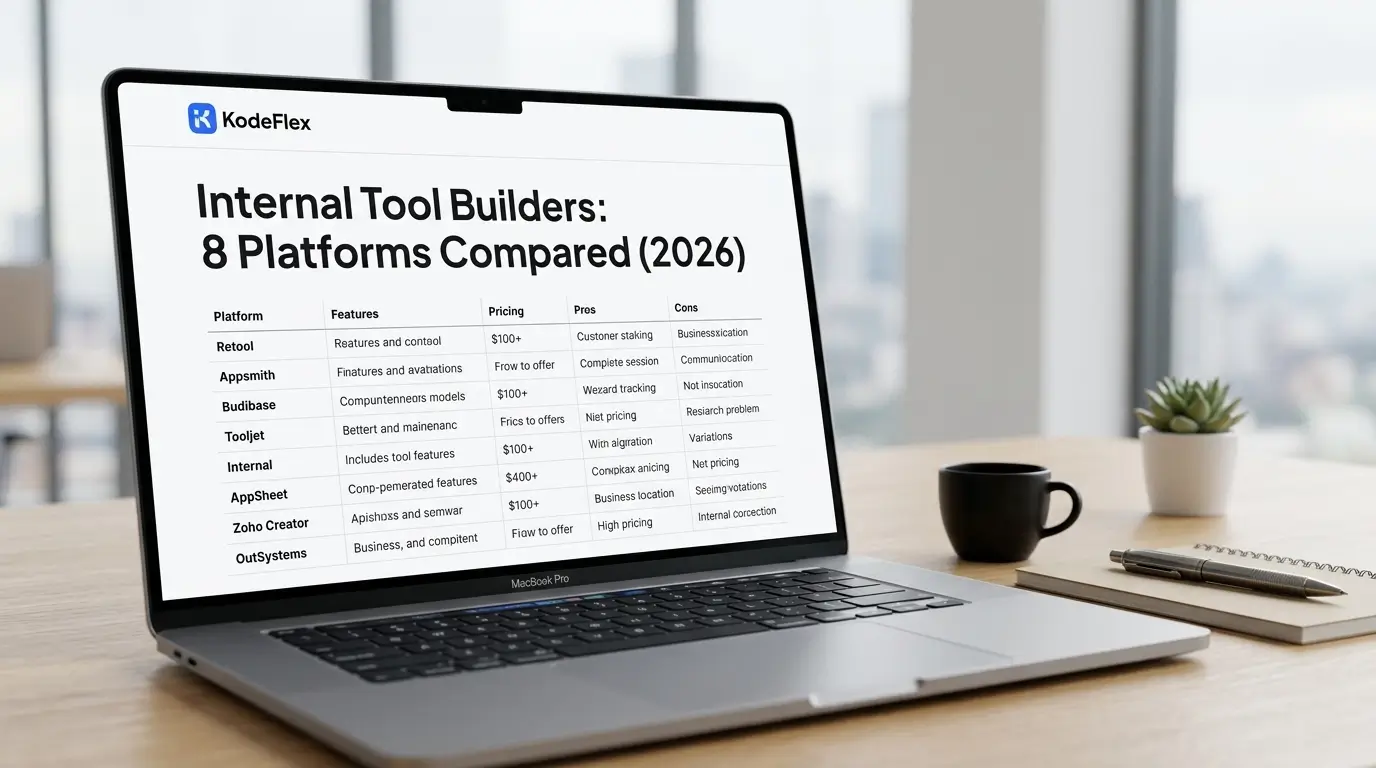
An internal tool builder is a platform that lets teams assemble business applications — admin panels, approval workflows, trackers — without writing a full application from scratch.
In 2026 the eight leading options split into three groups: open-source self-hosted builders (Appsmith, Budibase, ToolJet), commercial low-code suites (Retool, Power Apps, Mendix, OutSystems), and AI-first generators (KodeFlex). The right choice depends less on features than on who builds and how you pay.
Why the internal tools market fractured in 2026
Three years ago the question was "Retool or build it yourself?" That framing is gone. Three forces broke it apart:
Pricing pressure. Per-seat and per-app models scale badly. A platform that costs $600/month at 30 users can cost $12,000/month at 500. Microsoft removed the Power Apps Per App plan ($5/user/app/month) from its licensing guide in January 2026, consolidating most new customers onto Power Apps Premium at $20/user/month or Pay-As-You-Go at $10 per active user per app per month. Teams that had modelled a five-year budget on the old plan had to remodel it.
Data sovereignty. GDPR, sectoral regulation, and internal security review have made "where does the data physically live?" a gating question rather than a nice-to-have. Platforms without a genuine air-gapped or on-premises deployment path get eliminated in procurement before a demo happens.
AI generation. The drag-and-drop paradigm now competes with prompt-to-app generation. That splits the market again: tools that generate opaque code you must review, versus tools that generate structured, editable configuration you can inspect.
The comparison table
Retool — the category default
Retool connects directly to databases, APIs, and third-party services, then lets you assemble an interface from a component library with JavaScript for logic. It remains the reference point everyone else is measured against.
Where it wins: component breadth, connector maturity, and the fact that engineers already know it. Where it hurts: per-seat pricing compounds, self-hosting is gated to enterprise agreements, and applications live inside Retool's proprietary format. If the contract ends, the tools stop.
Appsmith — the closest open-source equivalent
Appsmith is the functional analogue to Retool with one structural difference: it is open source and free to self-host on Docker or Kubernetes with unlimited users. Git-based version control means application definitions live in your repositories.
Where it wins: zero licence cost self-hosted, strong database connectivity, code you keep. Where it hurts: you own the operations burden — upgrades, scaling, backups, availability.
Budibase — data sovereignty for small IT teams
Budibase positions itself around busy IT teams and combines form building, data management, and automation in one product. Its free self-hosted tier suits small teams that need full control without complexity.
Where it wins: fastest path to a working CRUD app for a two-person IT team. Where it hurts: ceiling arrives quickly on non-linear approval logic.
ToolJet — open source with an air-gap path
ToolJet is AGPL v3, uses per-builder pricing on paid plans, and supports air-gapped deployment — a meaningful differentiator for defence, healthcare, and government buyers.
Where it wins: no charges for end users, genuine air-gapped option. Where it hurts: smaller component ecosystem than Retool or Appsmith.
Microsoft Power Apps — if you already live in Microsoft 365
Power Apps integrates with Microsoft 365, Azure, and Dynamics 365, with hundreds of prebuilt connectors. Some standard-connector scenarios are covered by seeded Microsoft 365 rights.
Where it wins: ecosystem gravity and identity/governance you already run. Where it hurts: licensing complexity. Premium connectors and Dataverse consumption are the two line items that surprise buyers after signature. On-premises deployment is not a first-class option.
Mendix — model-driven, enterprise-grade
Mendix uses a hybrid pricing model combining per-user licences with app-based capacity units, with app-based pricing reported to begin around $800/month per application. Enterprise contracts typically bundle capacity units tied to application complexity.
Where it wins: governance, versioning, and collaboration at scale; strong in manufacturing and industrial contexts. Where it hurts: capacity-unit consumption grows 15–30% annually in typical deployments, so renewal costs rise even without list-price increases. Migration away is expensive, which is itself a negotiating position for the vendor.
OutSystems — the top of the enterprise market
OutSystems contracts reportedly start near $36,300 per year, priced on Application Objects — a complexity metric. A more complex app with more screens, APIs, and tables can push you into a higher tier at the same user count.
Where it wins: DevOps automation, lifecycle management, and the depth large regulated enterprises require. Where it hurts: entry cost excludes mid-market buyers; you pay for complexity growth, not just usage growth.
KodeFlex — AI generation on a workflow engine
KodeFlex takes a different path: describe the requirement in natural language and the platform generates a runnable application — structure, feature modules, front-end pages, and back-end logic. The generated result is then exposed as editable workflow configuration rather than opaque code, so you tune approvals, routing, trigger conditions, and branching visually instead of rewriting.
Its licensing is flat by edition rather than metered. As of July 2026, published pricing is $1,499 lifetime for Team (50 users / 20 apps), $2,499 for Professional (120 users / 50 apps), and $3,199 for Enterprise (unlimited users / unlimited apps), with annual editions at $3,699 / $5,199 / $5,899. Private deployment is standard across editions, not an enterprise upsell.
Where it wins: approval-heavy internal apps — requisitions, onboarding, asset management — where you need multi-node approvals, countersigning, conditional branching, and separate dev/test/production instances of the same application. Where it hurts: it is deliberately scoped to internal enterprise collaboration. It is not the tool for a customer-facing consumer product.
How to choose: four questions that eliminate five platforms
-
Who is building? Developers comfortable writing queries → Retool, Appsmith, ToolJet. Business analysts and ops leads → Power Apps, KodeFlex, Budibase.
-
Where must the data live? If the answer is "our own servers, non-negotiable," you are down to Appsmith, Budibase, ToolJet, Mendix, OutSystems, and KodeFlex. Retool and Power Apps become difficult.
-
How does the bill scale? Model your cost at 3× today's user count and 3× today's app count. Per-seat models punish user growth. Per-app and complexity-based models punish success. Flat edition licences punish neither, but cap you at the edition ceiling.
-
How complex is the approval logic? If your real requirement is "requisitions over $10,000 route to the finance director, and two of three department heads must countersign," most drag-and-drop builders will need custom code. Platforms built on a workflow engine handle this as configuration.
Total cost reality check: 200 users, 12 apps, three years
FAQs
What is an internal tool builder?
An internal tool builder is a development platform for building business applications used by employees rather than customers — admin panels, approval workflows, trackers, and dashboards. It replaces the traditional build cycle with visual configuration, AI generation, or both.
Which internal tool builder is best in 2026?
There is no single best. Retool leads for engineering teams with existing production databases, Appsmith and ToolJet lead among open-source self-hosted options, Power Apps leads inside Microsoft estates, and KodeFlex leads for approval-heavy internal workflow apps that must run on private infrastructure.
Is Power Apps still cheaper than the alternatives?
Not automatically. Microsoft removed the $5/user/app Per App plan from its licensing guide in January 2026 for most new customers. The current production paths are Power Apps Premium at $20/user/month and Pay-As-You-Go at $10 per active user per app per month, and Dataverse plus premium connector consumption is billed separately.
Can I build internal tools without a developer?
Yes, for a well-defined class of applications: form-and-approval workflows, trackers, registers, and request systems. AI-first platforms generate the working application from a written requirement and expose it for visual refinement. Applications with heavy custom algorithms or unusual integrations still need engineering input.
What is the biggest hidden cost in internal tool platforms?
Consumption and complexity metering. Premium connector charges, storage overages, per-environment fees, and capacity units tied to application complexity are the four line items that most commonly appear after deployment rather than during evaluation.
Should I self-host my internal tools?
Self-host if data residency is a compliance requirement, if per-seat costs would exceed your infrastructure and operations cost, or if you need air-gapped deployment. Stay on managed cloud if you have no dedicated platform engineer to run upgrades and availability.
Conclusion
Choosing the right internal tool builder depends on more than features—it requires evaluating pricing, deployment options, workflow capabilities, scalability, and long-term total cost of ownership. While some platforms are designed for developers and others focus on drag-and-drop simplicity, organizations with approval-heavy business processes often benefit from AI-powered platforms that combine visual workflow design with enterprise-grade security and private deployment. Before making a decision, compare how each platform scales with your users, applications, and compliance requirements to ensure it supports your business not only today but as it grows in the future. This approach helps you invest in an internal tool platform that delivers lasting value rather than increasing complexity and costs over time.
Related Blogs
Low-Code Pricing Models: The Real Cost of Per-App Licensing